
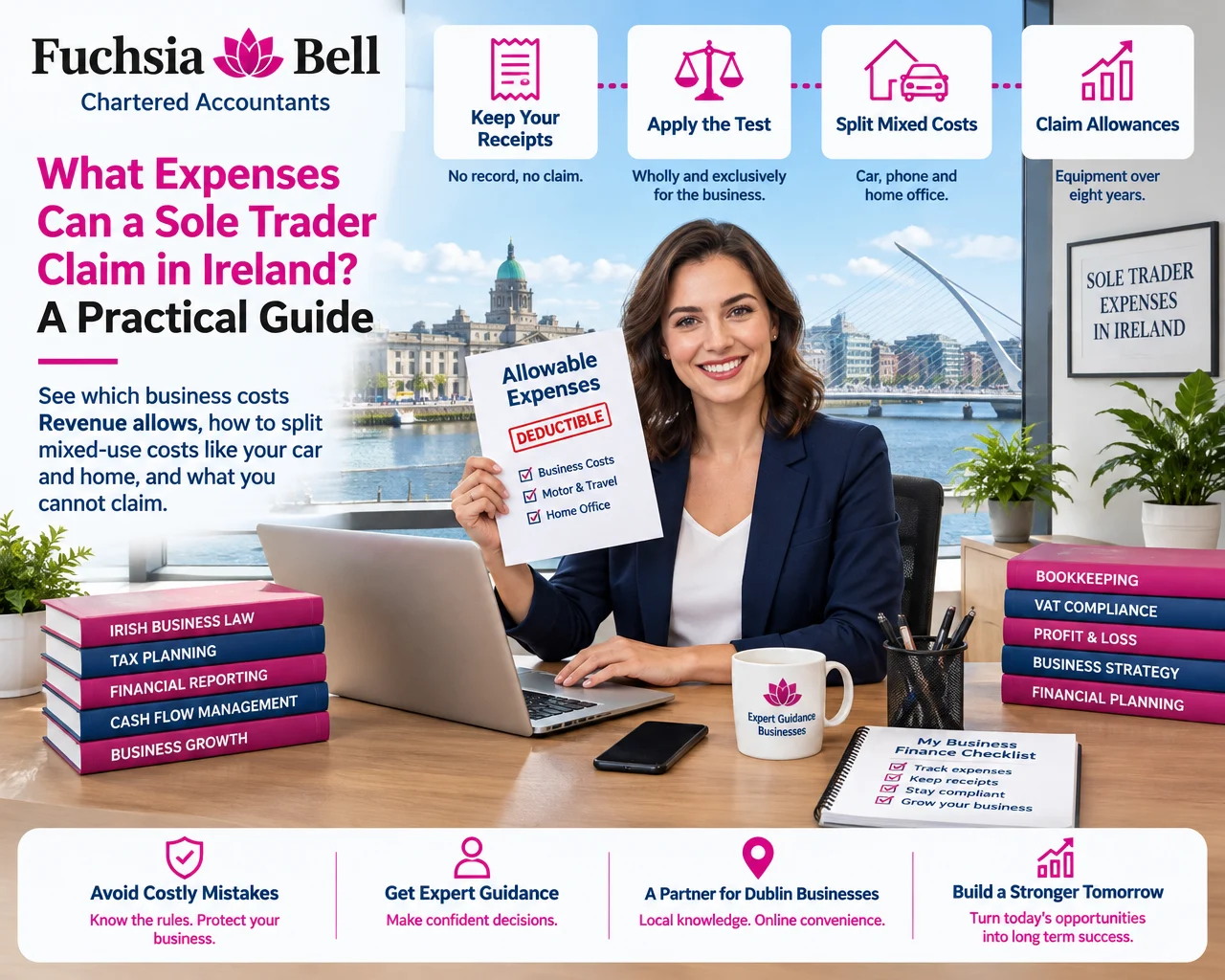
As a sole trader in Ireland, you can deduct any day-to-day cost incurred wholly and exclusively for your business: stock and materials, rent, insurance, phone and broadband, accountancy fees, staff wages, advertising, and the business share of your motor and home running costs. Equipment, tools and vehicles are not deducted in one go; you claim capital allowances on them, usually at 12.5% a year over eight years. What you cannot claim is anything personal, client entertainment, your own drawings, or fines and Revenue penalties. Every euro of allowable expense saves you tax at your marginal rate, which for many sole traders is about 50 cent in the euro once income tax, USC and PRSI are added up.
Key takeaways on sole trader expenses in Ireland
- An expense is allowable if it is a revenue (day-to-day) cost incurred wholly and exclusively for the business.
- Mixed-use costs, such as your car, phone and home, can be split, claiming only the business share.
- Equipment and vehicles are claimed through capital allowances at 12.5% a year over eight years. For cars, the cost is capped at €24,000 and reduced or removed for higher-emission models.
- Client entertainment is never deductible. Staff entertainment generally is.
- You must keep records for six years, and an expense you cannot support with a record is an expense you may lose in a Revenue audit.
What is the “wholly and exclusively” rule?
Section 81 of the Taxes Consolidation Act 1997 sets the basic test: a cost is deductible only if it is incurred wholly and exclusively for the purposes of the trade, and it must be a revenue cost rather than a capital one. A revenue cost is one you use up in running the business, such as fuel, materials or advertising. A capital cost buys something the business keeps, such as a van or a laptop.
In strict terms, a cost with any private element fails the test. In practice, Revenue accepts that some costs have a clearly identifiable business part, and allows that part to be claimed. Your car, your phone and the room you work from at home are the usual examples. The key is a reasonable, documented basis for the split.
Which expenses can a sole trader claim?
| Type of cost | What usually qualifies | Watch out for |
|---|---|---|
| Cost of sales | Stock, materials, subcontractors | Goods taken for your own use must be added back |
| Premises | Rent, rates, light and heat, repairs, cleaning | Improvements are capital, not repairs |
| Staff | Wages, employer PRSI, staff training | Your own drawings are not wages |
| Motor and travel | Business share of fuel, insurance, motor tax, repairs, leasing | Home to a regular workplace is private travel |
| Phone and internet | Business share of mobile and broadband bills | Claim only the business part |
| Insurance | Public liability, professional indemnity, employer’s liability | Personal health and life cover are not business costs |
| Professional fees | Accountancy, bookkeeping, business legal fees | Legal fees on buying a premises are capital |
| Finance | Interest on business loans, bank and card charges | Loan repayments themselves are not expenses |
| Marketing | Website, advertising, printing, sponsorship | Client hospitality is entertainment and is disallowed |
| Subscriptions and training | Trade bodies, journals, courses that update your existing skills | A course for a new qualification is usually not deductible |
If your spouse or partner genuinely works in the business, their wages can be deducted too, provided they are paid through payroll at a rate that matches the work. I explain how in employing your spouse in Ireland.
How do motor expenses work for a sole trader?
Most sole traders use one car for business and private driving, so the starting point is a mileage log. If 60% of your kilometres are business, you claim 60% of the running costs: fuel, insurance, motor tax, servicing and repairs.
The car itself is a capital cost. You claim capital allowances of 12.5% of the cost each year for eight years, again limited to the business share. For a car, the cost you can claim on is capped at €24,000 and is reduced, or removed entirely, for cars with higher CO2 emissions, so check your car’s emissions band before you buy. Leasing costs are restricted in a similar way. Vans and other commercial vehicles are not subject to the €24,000 car limit.
Travel from home to a regular place of work, such as your shop or yard, is treated as private. If your home is genuinely your base and you travel from it to different customer sites, those journeys are business travel.
Can you claim working from home as a sole trader?
Yes, if you work from home, you can claim a reasonable share of the household running costs: heat, light, broadband and home insurance, for example. A common basis is the proportion of rooms used for the business, adjusted for the hours they are used. Keep a note of how you worked out the figure.
There is one trap. If part of your home is used exclusively for the business, it may not be fully covered by principal private residence relief, the capital gains tax relief for your main home, when you sell the house. For most people working from a spare room that is also used privately, this does not arise, but it is worth a conversation before you claim a share of mortgage interest or rent.
What can’t a sole trader claim?
- Client and customer entertainment. Food, drink and hospitality for customers, suppliers or prospects is specifically disallowed.
- Your own drawings, income tax, USC and PRSI. These are your personal tax, not a business cost.
- Everyday clothing, even if you only wear it to work. Uniforms, protective clothing and specialist gear are allowable.
- Fines, penalties, Revenue interest and late filing surcharges.
- Ordinary lunches. Reasonable meals while travelling away from your normal place of business on a business trip can be claimed; your daily lunch near your usual base cannot.
- Capital items claimed as expenses. A €1,600 laptop is not a one-off expense; it goes through capital allowances.
How do capital allowances work?
Plant and machinery, which covers tools, equipment, computers, furniture and vans, qualifies for wear and tear allowances of 12.5% a year over eight years. If you use the item partly for private purposes, you claim only the business share.
Example: you buy a laptop for €1,600 and use it 90% for the business. The annual allowance is €1,600 × 12.5% × 90%, which is €180 a year for eight years.
If you are just starting out, costs you incurred in the three years before you started trading can also be claimed, as long as they would have been allowable once you were trading. Set-up costs such as a website, insurance and early advertising often qualify.
What records do you need to keep?
Revenue requires you to keep your business records for six years. That means receipts and invoices, bank statements, your mileage log and the working you used to split mixed costs. Photos of receipts on your phone are fine, as long as they are legible and stored somewhere safe. If receipts tend to disappear in your business, read why small businesses lose receipts before tax season.
Sole trader expenses checklist: the claims people most often miss
When I review a self-employed tax return, the problem is rarely a wrong claim. It is the allowable expenses that never made it onto the return. Work through this list of commonly missed sole trader expenses before you file:
- Accountancy and bookkeeping fees, including the fee for preparing last year’s return.
- Bank charges, card fees and interest on business loans, overdrafts and business credit cards.
- Software and subscriptions: accounting software, cloud storage, design tools and other apps used for the business.
- Website costs: hosting, domain names, maintenance and online advertising.
- Trade and professional memberships and the journals that come with them.
- Business insurance: public liability, professional indemnity, employer’s liability and the business share of vehicle insurance.
- Protective clothing, uniforms and small tools you use in your trade.
- The business share of your phone, broadband, heat and light if you work from home.
- Capital allowances on your van, laptop, tools and equipment, including items bought in earlier years that are still within their eight-year life.
- Pre-trading costs from the three years before you started, if they would have been allowable once trading.
Where do you claim sole trader expenses on your tax return?
Sole traders claim expenses on the Form 11 income tax return, filed through ROS. In the self-employment section, you enter your turnover and your expenses in the “Extracts from Accounts” panel, which works out your net profit. Capital allowances are claimed separately on the return, not mixed in with day-to-day expenses. Revenue does not ask you to send receipts with the return, but every figure has to be backed by the records described above.
Two points catch people out. First, if you are registered for VAT, claim your expenses net of the VAT you reclaim; if you are not registered, the VAT is part of the cost and is included. Second, the return for 2025 was due on 31 October 2026, or 18 November 2026 if you file and pay through ROS. If that has slipped, read what to do if you missed the tax return deadline. If you are deciding whether to register for VAT, see voluntary VAT registration in Ireland.
What I see with sole traders in Dublin, Cork and Kerry
Tradespeople in Cork and Kerry tend to under-claim on their vans and tools because they never set up capital allowances properly, while over-claiming on the family car. Freelancers and consultants in Dublin usually work from home and forget to claim any share of their household bills at all. Kerry B&B and guesthouse owners have the most complicated split, because the business and the family home are the same building, and the basis needs to be agreed and written down. In each case, the fix is a simple system set up once, not a scramble every October.
Making sure you claim everything you are entitled to
Getting expenses right is the easiest way for a sole trader to pay the correct tax, no more and no less, and it is a core part of our accounting service for sole traders. If you would like me to look over what you are claiming before your next return, you can book a free 30-minute business check with me at Fuchsia Bell.
Related guides for sole traders and the self-employed
- Missed the tax return deadline in Ireland? What to do now
- Tax clearance certificate in Ireland: who needs one and how to get it
- What happens during a Revenue audit in Ireland
- Turnover vs profit: what Irish business owners get wrong
- Bookkeeping software or a bookkeeper: which is right for you?
FAQ About Sole Trader Expenses in Ireland
Can a sole trader claim their mobile phone bill?
Yes, the business share. If the phone is used mainly for work, a high percentage is reasonable, but keep a note of the basis. A phone used only for the business can be claimed in full.
Can I claim my car if it is also the family car?
Yes, but only the business share of the running costs and capital allowances, based on your mileage log. Without a log, it is hard to support the percentage you claim.
Can I claim the cost of my work clothes?
Only if they are a uniform, protective clothing or specialist gear for your trade. Ordinary clothing is not allowable, even if you only wear it for work.
How long do I need to keep receipts in Ireland?
Six years. Revenue can ask to see the records behind any figure in your return during that time.
How much tax does a business expense actually save?
It depends on your marginal rate. For a sole trader paying tax at the higher rate, each €100 of allowable expense saves roughly €50 in income tax, USC and PRSI combined. At the standard rate, the saving is lower.
Is there a flat rate for working from home for sole traders in Ireland?
No. Remote working relief and the €3.20 a day tax-free payment are for employees. A sole trader instead claims a reasonable business share of the actual household costs, such as heat, light and broadband, and should keep a note of how the share was worked out.
Can I claim expenses from before I registered as self-employed?
Yes. Costs incurred in the three years before you started trading can be claimed, as long as they would have been allowable if you had already been trading. They are treated as incurred on the day the trade started.
Should I include VAT in my business expenses?
If you are registered for VAT and reclaim it, enter your expenses net of VAT. If you are not registered, the VAT is part of the cost and you claim the full amount you paid.
Can a sole trader claim a laptop or van as an expense?
Not in one go. Equipment, computers and vans are capital items, so you claim capital allowances of 12.5% of the cost a year over eight years, limited to the business share if you also use them privately.