
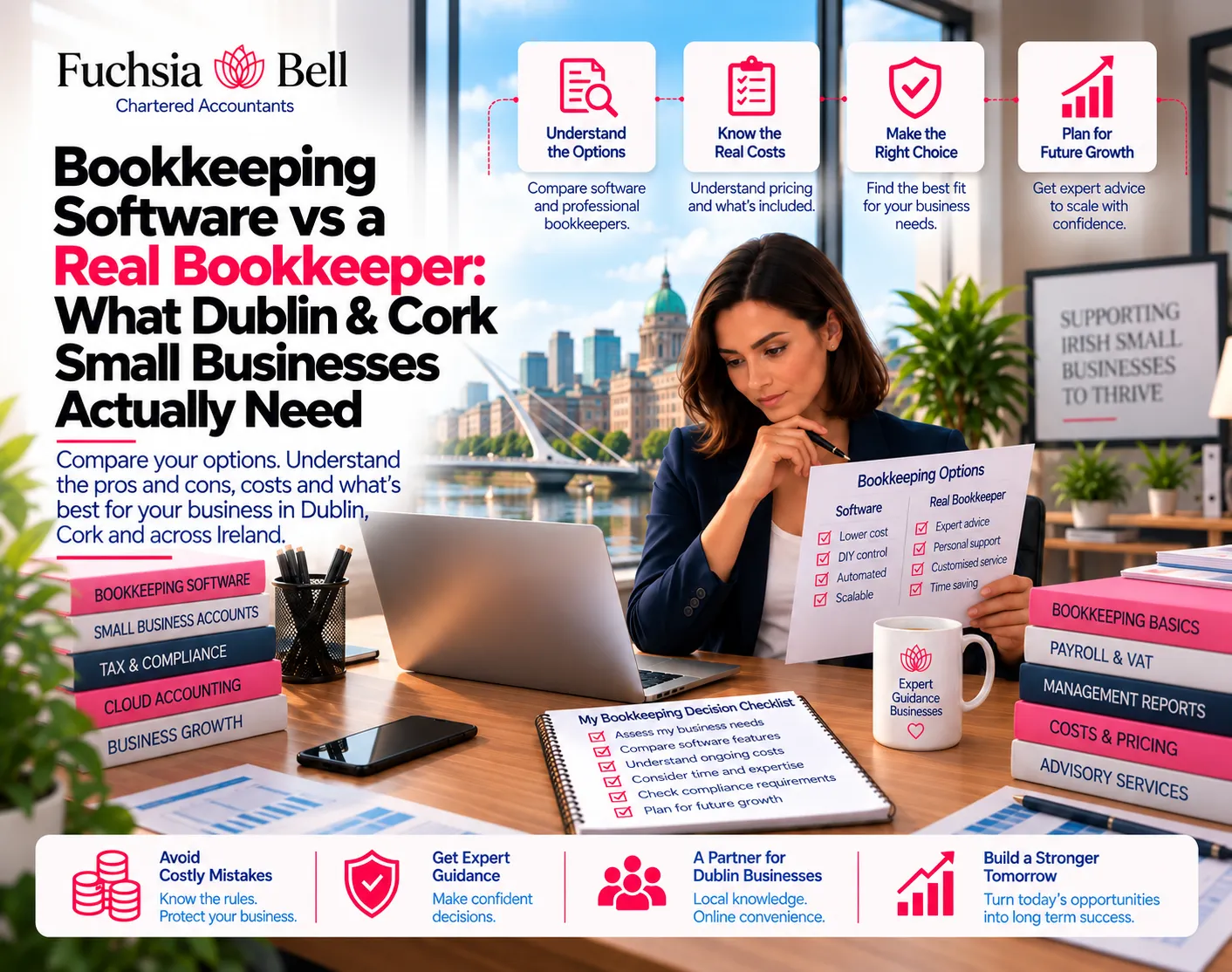
It’s October, the self-assessment deadline is weeks away, and a lot of small business owners are staring at a year of half-categorised bank transactions wondering whether the app they pay for every month was ever enough. The bookkeeping software vs bookkeeper question comes up with me constantly. My honest answer: software records your numbers, but it doesn’t judge them. Below I set out what each one does well, what mistakes cost in real euro, and how to work out which mix suits your business.
Key takeaways
- Revenue requires you to keep business records for 6 years, and failing to keep proper records carries a €3,000 penalty.
- You must register for VAT once turnover passes €42,500 for services or €85,000 for goods in a 12-month period.
- Most VAT-registered businesses file a VAT3 every two months, due by the 19th of the following month, or the 23rd if you file and pay on ROS.
- A late tax return adds a surcharge of 5% of the tax due if filed within two months of the deadline, and 10% after that.
- The 2025 Form 11 deadline is 31 October 2026, or 18 November 2026 if you file and pay through ROS.
Is bookkeeping software enough for a small business in Ireland?
Bookkeeping software is enough for some small businesses in Ireland, usually a sole trader with a single income stream, few expenses, no staff and either no VAT registration or very simple VAT. Once you add VAT, employees, stock or a limited company, software alone tends to miss the judgement calls that Revenue cares about.
The law doesn’t require a bookkeeper. It requires records. Under section 886 of the Taxes Consolidation Act 1997, you must keep records that allow a correct return to be made, and keep them for six years. Software can help you do that, and good software makes it much easier.
What software can’t do is decide whether something is right. It’ll happily file a personal Amazon order under “office supplies” if that’s what you tell it.
What does bookkeeping software do well?
Bookkeeping software does the repetitive work well. It pulls in bank transactions automatically, matches payments to invoices, captures receipts from a phone photo, produces VAT reports and shows you, at any moment, roughly where your business stands. For a tidy, disciplined owner, that’s a big time saving.
The best features for small Irish businesses are:
- bank feeds that pull transactions in daily
- invoicing with automatic payment reminders
- receipt capture, so paper doesn’t pile up in the van or the drawer
- VAT reports that line up with the VAT3 return
- real-time profit and cash figures
If you’re new to this, our guide to what cloud accounting is explains how the software side works.
What does a real bookkeeper do that software can’t?
A real bookkeeper checks that every transaction is in the right place and treated the right way for tax. They catch personal spending in the business account, apply the correct VAT treatment, reconcile the bank properly, chase missing receipts, and spot problems early, before they turn into a surcharge or an awkward Revenue letter.
Here’s where I see software-only books go wrong most often:
- VAT treatment. Ireland has several VAT rates, from the 23% standard rate down to 0%, plus reverse-charge rules for some services and EU purchases. Software uses whatever rate you or a bank rule assigns.
- Capital vs day-to-day costs. A new laptop or van isn’t a normal expense. It’s claimed through capital allowances over several years.
- Mixed personal and business spending. Common with sole traders, and easy to miss.
- Unreconciled accounts. A bank feed isn’t the same as a reconciled bank account.
- Missing the VAT threshold. Software rarely warns you that you’ve crossed €42,500 in services over a rolling 12 months.
In short: software is a tool, and a bookkeeper is the person who makes sure the tool’s output is right.
What does it cost you when the books go wrong?
When the books go wrong, it costs you in surcharges, interest and penalties. A late return adds 5% or 10% of the tax due, Revenue charges interest on late tax at 0.0219% a day, and failing to keep proper records carries a €3,000 penalty. Lost reliefs and missed expenses cost more again.
Here’s a simple example. Say your 2025 income tax bill is €8,000:
| Situation | Extra cost |
|---|---|
| Filed and paid on time | €0 |
| Filed in December 2026 (within two months of the deadline) | 5% surcharge: €400 |
| Filed in January 2027 or later | 10% surcharge: €800 |
| Records not kept properly | Penalty of €3,000 on top |
That’s before interest on the late payment, and before the cost of an accountant untangling a year of messy books in a hurry. If you’d like the self-assessment side spelled out, we have a clear guide to the self-assessment tax return in Ireland.
Which option fits your small business?
The right option depends on how complex your business is. Software alone suits a simple sole trader with no VAT and no staff. Software plus a bookkeeper suits most VAT-registered businesses. Fully outsourced bookkeeping suits companies with staff, stock or several income streams, and owners who’d rather spend their time on the work that pays.
| Option | Who it suits | What you do | Main risk |
|---|---|---|---|
| Software only | Sole trader, simple income, no VAT, no staff | Everything: entering, categorising, checking | Errors nobody catches until year-end |
| Software plus a bookkeeper | VAT-registered sole traders and small companies | Snap receipts, answer occasional questions | Low, if the bookkeeper reviews monthly or bi-monthly |
| Fully outsourced bookkeeping | Companies with staff, stock or several income streams | Send documents, review reports | Lowest, as long as you still read the numbers |
A good rule of thumb: if you’re registered for VAT, you probably need a person in the loop at least every VAT period. That’s six times a year for most businesses. For VAT returns themselves, our VAT return services in Ireland handle the VAT3 from start to finish.
Is it cheaper to do your own bookkeeping?
It’s cheaper in cash, but not always in reality. Doing your own bookkeeping saves a bookkeeper’s fee, but costs your evenings, and mistakes can cost more than the fee would have. The fair test is to compare the fee with what your time is worth and with the surcharges, penalties and missed claims you’d risk.
I won’t quote prices here, because fees depend on transaction volume, VAT, payroll and how organised your records are. What I will say is that a bookkeeper who keeps your books clean all year usually makes your accountant’s year-end work quicker, which brings that bill down too.
Getting help in Dublin, Cork and across Ireland
At my practice, Fuchsia Bell, we’re chartered accountants based in Castlemaine, Co. Kerry, and we work online with small businesses in Dublin, Cork, Wexford and right across Ireland. A lot of Dublin small businesses we work with are service companies and contractors who’ve outgrown a spreadsheet. If that sounds familiar, our online accountants in Dublin can pick up your books wherever they’re at.
Cork small businesses, from trades to hospitality, can work with our chartered accountants in Cork in exactly the same way. Bookkeeping and tax rules are national, so the process doesn’t change by county. If you want a wider look at your business, see our small business accounting services. Revenue’s page on VAT registration thresholds is worth bookmarking too.
Frequently Asked Questions
Do I legally need a bookkeeper in Ireland?
No. Irish law doesn’t require you to hire a bookkeeper. It requires you to keep proper records that allow a correct tax return to be made, and to keep them for six years. You can do that yourself, with software or a spreadsheet, as long as the records are complete, accurate and backed up by receipts and invoices.
How long do I need to keep business records in Ireland?
Six years, in most cases. Revenue requires business records to be kept for six years, and longer if a return was filed late or an inquiry, audit or appeal is open. The obligation also continues after a business closes. Failing to keep proper records carries a €3,000 penalty.
Can I use a spreadsheet instead of bookkeeping software?
Yes. A spreadsheet is fine for a small, simple business, as long as it records every sale and expense with supporting documents. It gets harder once you’re VAT-registered or have more than a handful of transactions a week, because errors are easy to make and hard to spot.
Does a bookkeeper file my tax return?
Not usually. A bookkeeper keeps your records accurate and up to date. Your accountant then uses those records to prepare your year-end accounts and file your tax return, such as a Form 11 or a CT1. Some firms, including chartered accountancy practices, offer both under one roof.
When should a small business hire a bookkeeper?
A small business should consider hiring a bookkeeper when it registers for VAT, takes on staff, starts carrying stock, or spends more than a few hours a month on the books. Another sign is reaching October each year with a pile of unsorted receipts and the 31 October deadline looming.
Next step
If you’re not sure whether your software is doing enough, I’m happy to give you a straight answer. Have a look at our bookkeeping services to see how it works, or send me a quick note through my contact page.
Related guides on bookkeeping and records
- Why Do So Many Small Businesses Still Lose Receipts Before Tax Season?
- Turnover vs Profit: What Irish Business Owners Often Get Wrong
- Why Do Small Irish Businesses Outgrow Their First Accountant?
- What Expenses Can a Sole Trader Claim in Ireland? A Practical Guide
- Why Can a Profitable Business Still Run Out of Cash in Ireland?
If you would rather have this handled for you, see our bookkeeping and year-end accounts or book a free 30-minute business check.