
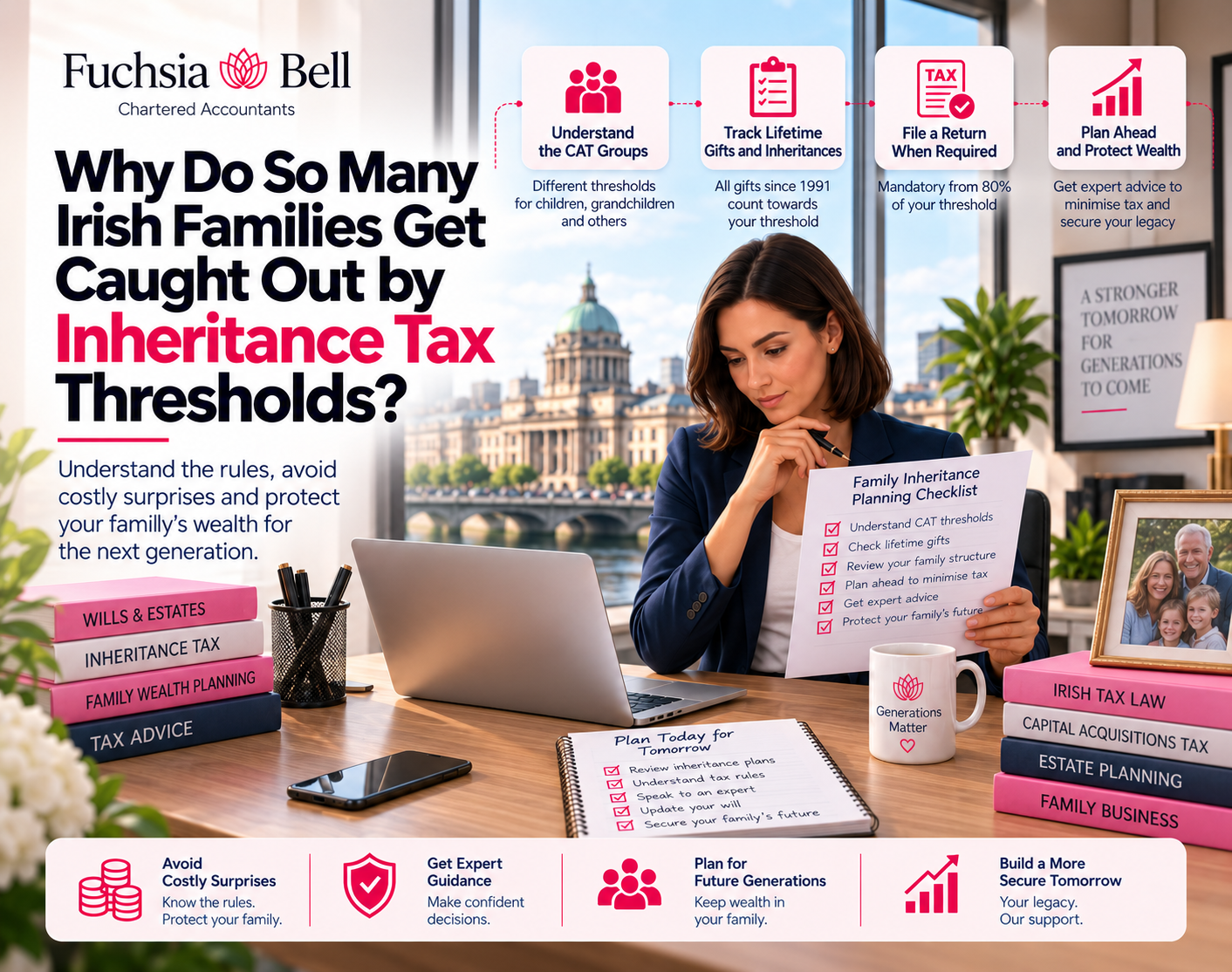
A child inheriting from a parent can receive up to €400,000 tax-free. A grandchild inheriting from a grandparent gets a tenth of that, €40,000, before Capital Acquisitions Tax starts at 33%. That single gap between the two thresholds, not the tax rate itself, is where most Irish families run into an unexpected bill, because the relationship on paper matters far more than most people assume until it’s their family sorting out an estate.
CAT doesn’t work like a lot of the tax system people are already familiar with. It isn’t calculated per gift, per year, or even per lifetime event. It’s a running lifetime total, tracked per relationship group, going back further than most people realise.
The Three Thresholds, and the Gap That Catches People Out
Every beneficiary falls into one of three groups depending on their relationship to the person giving the gift or leaving the inheritance. Group A covers a child inheriting from a parent, with a threshold of €400,000. Group B covers siblings, nieces, nephews, grandchildren, and grandparents, at €40,000. Group C covers everyone else, friends, unmarried partners, distant relatives, at €20,000. The rate above whichever threshold applies is a flat 33%, regardless of which group is involved. Understanding capital acquisitions tax starts with knowing which group actually applies, not assuming a family relationship automatically means the generous Group A figure.
Why the Threshold Isn’t Really a Threshold, It’s a Lifetime Total
Every gift and inheritance received from anyone within the same group counts toward that group’s single lifetime threshold, and the counting goes back to 5 December 1991. Someone who received a €150,000 gift from a parent years ago, paid no tax on it at the time because it sat under the threshold, and then later inherits €350,000 more from the same parent, has a combined Group A total of €500,000. That’s €100,000 over the current threshold, triggering €33,000 in CAT on an inheritance that, looked at in isolation, seems to sit comfortably within the tax-free amount. Getting tax services advice that actually tracks lifetime totals across a family, not just the most recent transfer, is what catches this before Revenue does.
The Outdated Numbers Still Circulating Online
The current thresholds took effect for gifts and inheritances received on or after 2 October 2024. Before that date, the figures were considerably lower: €335,000, €32,500, and €16,250 for Groups A, B, and C. A meaningful amount of content still online, older guides, forum posts, and unrevised articles, quotes those superseded figures as current, and a family working from a two-year-old bookmark or a search result that hasn’t been checked against the live tax returns filing rules can badly misjudge their actual exposure.
Rising Property Values Are Doing the Rest
A family home that would have sat comfortably under the Group A threshold a decade ago now routinely exceeds it in parts of the country where property values have moved the most. This isn’t a change in the tax rules catching people out. It’s the same €400,000 figure applying to a property market that’s moved considerably since the threshold was last set. Where a disposal happens alongside an inheritance, a same-event credit can generally offset capital gains tax paid against the CAT due on the same transaction, so the two taxes don’t simply stack on top of each other without any relief at all.
Grandchildren Face the Steepest Gap of All
A grandparent leaving a meaningful sum directly to a grandchild, common where an intervening generation is skipped for estate planning reasons or simply because a grandparent wants to provide for a grandchild directly, falls under the €40,000 Group B threshold rather than Group A, unless the grandchild’s parent has already died. That single distinction, missed easily in informal family planning, is often where the largest unplanned CAT bills actually originate. A broader look at how Irish families structure generational transfers to avoid this exact gap is covered on geroconnor.info.
The Small Gift Exemption Isn’t What Most People Think
A Small Gift Exemption allows €3,000 per person, per year, completely outside CAT and outside the lifetime threshold calculation entirely. The confusion is in the per person part. It applies per disponer, meaning a beneficiary can receive €3,000 each from multiple different people in the same year, all exempt, but a single person can’t stretch their own gift to a beneficiary beyond €3,000 by spreading it across categories. Where a beneficiary also has cross-border family, a disponer living outside Ireland, the expat tax position of the giver doesn’t change whether Irish CAT applies. Irish tax residency of the beneficiary is what triggers the Irish liability, regardless of where the person giving the gift actually lives.
What Happens Once You Cross 80% of Your Threshold
A CAT return, Form IT38, becomes mandatory once the cumulative benefits received within a group exceed 80% of that group’s threshold, not only once the threshold itself is actually breached. Someone with a Group A lifetime total of €320,000, still €80,000 under the €400,000 threshold, has already crossed the 80% filing trigger and needs to file, even though no CAT is actually due yet. This surprises people who assume filing only becomes relevant once tax is owed. Declaring this correctly alongside a broader income tax return position for the year avoids a mismatch between what Revenue expects filed and what’s actually been submitted.
Frequently Asked Questions
Does the Small Gift Exemption count toward the lifetime threshold at all?
No. A gift that qualifies under the €3,000 Small Gift Exemption is excluded entirely from the lifetime aggregation calculation, not just taxed at zero within it.
What happens if a beneficiary inherits from someone who lived and died abroad?
Irish CAT generally still applies if the beneficiary is Irish resident, regardless of where the disponer lived or where the assets were located, subject to the specific double taxation agreement in place with that country.
Do stepchildren get the same Group A threshold as biological children?
Yes. Stepchildren and legally adopted children are treated the same as biological children for Group A purposes.
Can a married couple combine their CAT thresholds?
No, thresholds are personal to each beneficiary, though transfers directly between spouses or civil partners are entirely exempt from CAT regardless of value.
How far back does Revenue actually check for previous gifts within a group?
The aggregation rule looks back to 5 December 1991 for any gift or inheritance within the same group, so a decades-old gift can still reduce the tax-free amount available today.
Checking the Running Total Before It Becomes a Problem
The families who avoid an unexpected CAT bill aren’t the ones with smaller estates. They’re the ones who know which group threshold actually applies to each relationship, and who track the lifetime total rather than assessing each gift or inheritance as though it stands alone. A fuller picture of how online chartered accountants work with families on estate and gift planning is covered on geroconnor.info as well.