
By Ger O’Connor (FCA), Founder & Managing Director, Fuchsia Bell Chartered Accountants. Fellow of Chartered Accountants Ireland with over 20 years advising Irish startups, SMEs and owner-managers. Last updated: 13 August 2026.
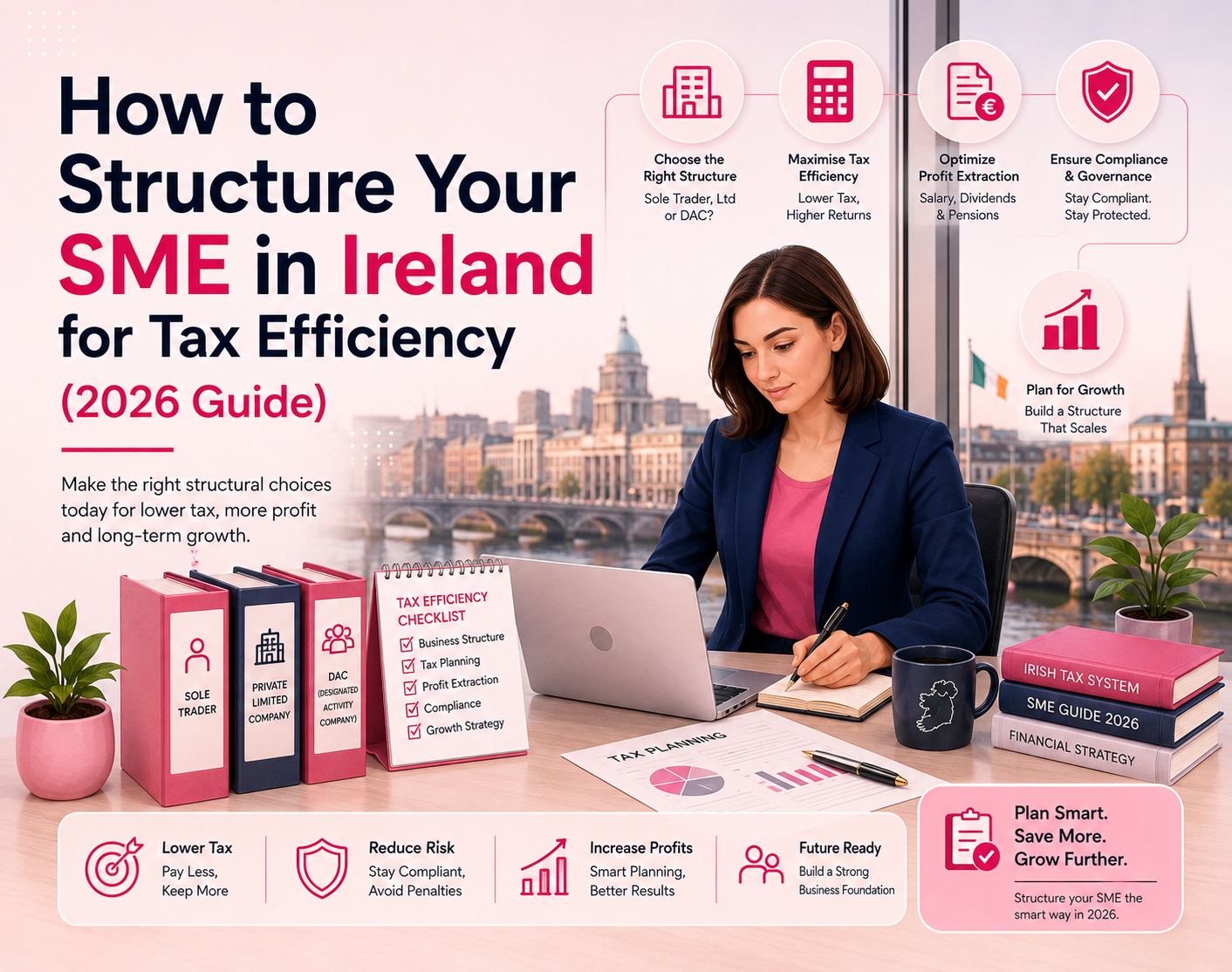
For most Irish SMEs, a tax-efficient business structure means one thing: a limited company, with profits you don’t personally need left inside it at 12.5% instead of taxed on you at up to 52%. That single decision is worth more than every expense claim you will ever make. But it only works if the rest of the structure follows, and the traps that catch owner-directors are rarely the ones they worry about.
This guide covers the choice itself, the reliefs worth claiming in 2026, the three ways to get money out of a company, and the surcharge that quietly undoes the whole plan for professional service firms. All figures are current for the 2026 tax year.
Sole trader or limited company: which is more tax-efficient?
A limited company is more tax-efficient once your profits exceed what you need to live on. A sole trader pays income tax, USC and PRSI on every euro of profit in the year it is earned, whether or not it is drawn. A company pays 12.5% corporation tax on trading profits, and you only pay personal tax on what you take out.
Here is what the 2026 rates actually look like on each side.
| Feature | Sole trader | Private limited company (LTD) |
|---|---|---|
| Tax on profits retained in the business | Up to about 52% (55% on self-employed income above €100,000) | 12.5% on trading profits; 25% on rent, interest and most foreign dividends |
| Legal status | You and the business are the same person | Separate legal entity |
| Liability | Unlimited and personal | Limited to what you put in, subject to personal guarantees |
| CRO filings | None | Annual return (Form B1) plus financial statements |
| Pension funding | Personal contributions, capped by age and the €115,000 earnings limit | Company contributions, deductible against corporation tax |
| Tax-free non-cash benefits | Not available | Up to €1,500 a year per director or employee |
| Setup and running cost | Low | Higher: accounts, secretarial, payroll |
The takeaway from that table is narrower than it looks. Incorporation does not reduce the tax on money you spend on your own life. It reduces the tax on money you leave in the business. If you draw every euro you earn, the two structures land in roughly the same place and the company just costs you more in fees.
What the difference is worth in cash
Take the next €40,000 of profit above your standard rate band, on the assumption you don’t need it personally this year.
- As a sole trader: 40% income tax, 8% USC and 4.2% PRSI. Roughly €20,900 gone, leaving about €19,100.
- Inside a company: €5,000 corporation tax, leaving €35,000 available to reinvest, hire from, or fund a pension with.
That gap is close to €16,000 of working capital on a single year’s profit. Be clear about what it is, though: a deferral, not a permanent saving. Take that €35,000 out as salary later and you pay personal tax then. The advantage is that you choose the year, and in the meantime the money is working in the business rather than sitting with Revenue.
A note on the 15% rate. Ireland’s Pillar Two minimum tax applies only to groups with consolidated revenue above €750 million. If you are reading this guide, it does not apply to you. Your rate is 12.5%.
Structure sets the ceiling on what you keep. Reliefs decide how much of that ceiling you actually reach.
Which start-up tax reliefs can an Irish SME claim in 2026?
Three are worth real money to a growing SME: Section 486C start-up relief, the R&D tax credit, and KEEP share options. Each has narrow eligibility, and the first one excludes a large slice of Irish businesses outright.
Section 486C: up to five years of corporation tax relief
This is the relief most commonly cited under the wrong section number. It is Section 486C of the Taxes Consolidation Act 1997, and for trades commencing on or after 1 January 2018 it runs for five years, not three.
How it works:
- Full relief where your total corporation tax liability for the period is €40,000 or less.
- Marginal relief on a sliding scale between €40,000 and €60,000.
- The amount is capped by the employer’s PRSI you actually pay: €5,000 per employee, €40,000 in total per accounting period. From 2025, Class S PRSI remitted for directors counts too, limited to €1,000 per director.
- Unused relief can generally be carried forward.
The cap is the point of the relief. It is designed to reward companies that create jobs, so a one-person company with no payroll gets very little from it. The trade must also be genuinely new, and it must commence by 31 December 2026 under the current legislation. Companies in land development, mineral extraction and, critically, professional services are excluded.
R&D tax credit: now 35%
Budget 2026 raised the research and development tax credit from 30% to 35% for accounting periods beginning on or after 1 January 2026. Combined with the 12.5% deduction on the same spend, the effective benefit reaches about 47.5%.
For loss-making startups the cash element matters more than the rate. The credit is payable by Revenue over three annual instalments, and the amount claimable in full in year one rose to €87,500. Software development, process engineering and product work all commonly qualify, though the test is scientific or technological advance, not novelty to your business. Documentation is where most claims fail, so record the technical uncertainty as you go rather than reconstructing it eleven months later.
KEEP: share options without the exercise tax bill
The Key Employee Engagement Programme lets qualifying SMEs grant share options with no income tax, USC or PRSI when the employee exercises them. Tax arises only on eventual disposal, at 33% capital gains tax. Budget 2026 extended the scheme to 31 December 2028, subject to European Commission approval.
Options must be reported to Revenue within 30 days of grant. Miss that and the tax treatment for those options is lost, which is an expensive way to learn an administrative rule.
Reliefs reduce the company’s bill. Getting the money from the company to you is a separate problem, and a bigger one.
How should a director take money out of an Irish limited company?
Salary first up to your credits and 20% band, pension next, dividends last. Salary and pension contributions are deductible against the company’s 12.5% corporation tax. Dividends are not, because they come out of profits already taxed, so the same euro gets hit twice.
1. Salary
Pay yourself enough to use your Personal Tax Credit (€2,000) and Earned Income Credit (€2,000), and to fill the 20% band: €44,000 for a single person in 2026, €53,000 for a married couple with one income. Every euro of that salary reduces the company’s taxable profit.
Above the band, the marginal rate climbs to roughly 52%, and salary stops being the efficient route. Note also that Class S PRSI rises from 4.2% to 4.35% on 1 October 2026, and employer’s PRSI from 11.25% to 11.40%, so payroll costs are slightly higher in the final quarter than the first three.
2. Executive pension: the strongest lever available
Company pension contributions are the closest thing Irish tax law offers an owner-director to a free lunch. They are deductible as a business expense where they meet the wholly and exclusively test, they create no benefit-in-kind for you, and the fund grows free of income tax, CGT and dividend withholding tax.
Two rules shape how much you can put in:
- PRSAs: since 1 January 2025, employer contributions are capped at 100% of the employee’s emoluments for the year. Your salary level therefore sets your funding ceiling.
- Occupational and executive schemes: funding is assessed actuarially on salary, service and existing benefits, which often allows considerably more for an older director with a long service history.
At retirement you can generally take 25% of the fund as a lump sum. The first €200,000 is tax-free, the next €300,000 is taxed at 20%, and anything beyond that at your marginal rate. Watch the Standard Fund Threshold as well: it is €2.2 million from 1 January 2026, rising in stages to €2.8 million by 2029, and funds above it face a 40% chargeable excess charge.
3. Dividends
Dividends carry 25% dividend withholding tax at source, and are then assessed on you for income tax, USC and PRSI at your marginal rates, with the DWT credited against the final bill. Because the company has already paid corporation tax on the same profits, dividends are usually the least efficient route for a working director.
They still have a place: paying out a shareholder who takes no salary, satisfying an investor, or clearing profits to avoid the surcharge described next.
4. The €1,500 you are probably not claiming
Under the Small Benefit Exemption, a company can give each director and employee up to €1,500 a year in non-cash benefits with no income tax, USC or PRSI. Since 2025 this can be split across up to five separate benefits rather than one or two.
The saving is real. To leave a proprietary director with €1,500 net through payroll, the company needs to pay roughly €3,100 in gross salary. The voucher route costs €1,500 flat. The rules are strict: non-cash only, not convertible to cash, purchased with company funds, and never as part of a salary sacrifice. Each benefit must also be reported to Revenue in real time under Enhanced Reporting Requirements.
The close company surcharge: the trap that catches professional firms
A close company that leaves rental or investment income undistributed for more than 18 months after the end of the accounting period pays a 20% surcharge on that income. Professional service companies face a second charge: 15% on half of their undistributed professional income. A €2,000 de minimis applies to each.
This is where the 12.5% headline stops being the whole story. For a consultancy, an engineering practice or a contractor company, the surcharge can push the effective rate on retained professional profits from 12.5% to around 19%. Most owner-directors discover this at the year-end meeting, not before.
You can manage it. The surcharge is reduced or eliminated by distributing the relevant income within the 18-month window, and salary and pension contributions reduce the distributable profit in the first place. But it needs to be modelled during the year, and it is another reason professional service companies should not assume the standard SME playbook applies to them. Revenue sets out the mechanics in its guidance on the surcharge for close companies.
Structure and extraction are the strategy. Compliance is what keeps it intact, and 2026 brought two changes worth knowing about.
VAT, payroll and CRO compliance in 2026
VAT thresholds and the cash receipts basis
Registration is compulsory once turnover exceeds, or is expected to exceed, €42,500 for services or €85,000 for goods in a twelve-month period. These figures have applied since 1 January 2025, and plenty of guides still quote the older €37,500 and €75,000. If you supply both, the higher goods threshold only applies where at least 90% of turnover comes from goods.
The bigger cash flow decision is the basis. On the invoice basis you owe Revenue the VAT when you issue the invoice, regardless of whether the client has paid. On the cash receipts basis you account for it when the money actually arrives. Eligibility runs to turnover under €2 million, or where at least 90% of your supplies go to customers who cannot reclaim VAT. For any service business with 60- or 90-day payers, this is one of the highest-value applications you can make.
Payroll: real-time reporting, and now auto-enrolment
Under PAYE Modernisation, every payment to an employee or director must be reported to Revenue on or before the payment date. Irregular director salaries are the usual weak point, and they need to run through ROS before the money moves, not after.
The larger change is My Future Fund, Ireland’s auto-enrolment pension system, which went live on 1 January 2026. Employees aged 23 to 60 earning over €20,000 who are not already in a payroll pension are enrolled automatically. Employers contribute 1.5% of gross pay in the first three years, matched by the employee with a 0.5% State top-up, on earnings up to €80,000. Contributions step up every three years until they reach 6% by year ten. Budget for it now, because the rate that feels small in 2026 does not stay small.
CRO filings and audit exemption
Every Irish company files an annual return (Form B1) with the Companies Registration Office. Late filing brings penalties, and it used to bring something worse: automatic loss of audit exemption for two financial years on a single missed deadline.
That changed on 16 July 2025. Under Section 22 of the Companies (Corporate Governance, Enforcement and Regulatory Provisions) Act 2024, a small or micro company now loses audit exemption only after filing late twice within a rolling five-year period. Late filings before that date do not count towards the test. Chartered Accountants Ireland, citing the CRO’s 2024 annual report, noted that more than 16,000 companies incurred late filing fees that year, at an average of just over €600 each.
So the first slip is now survivable. The second one costs you two years of audit fees, which for a small company typically starts around €1,800 a year.
Your 2026 SME tax efficiency checklist
- Are your profits consistently above what you draw? If yes, incorporation is likely to pay for itself.
- Did your trade commence on or after 1 January 2018 and do you pay employer’s PRSI? Check Section 486C eligibility.
- Are you isolating qualifying R&D spend for the 35% credit, with the technical documentation kept as you go?
- Is your salary at least high enough to use both €2,000 credits and the 20% band?
- Are company pension contributions running, and does your salary support the funding level you want?
- Have you used the €1,500 small benefit exemption this year, reported through ERR?
- If you are a professional service company, has anyone modelled the 15% surcharge before year end?
- Are you on the cash receipts basis for VAT, if you qualify?
- Is auto-enrolment set up and budgeted?
- Is your CRO annual return date diarised, with the 56-day filing window built in?
Where founders actually lose money
Rarely on the big structural call. Almost everyone gets to a limited company eventually. The losses come from the year that passed without a pension contribution, the R&D claim nobody documented, the surcharge that arrived nineteen months after the profit was earned, and the €1,500 in vouchers that expired unused.
All of those are calendar problems, not tax problems. They are decisions that had to be made before a year-end that has already gone. Which is why the useful version of tax planning happens in month eight, with real numbers in front of you, rather than in month twenty with a set of finished accounts and no options left.
A structure that suits a scaling software company will not suit a family retail business or a two-partner consultancy. Get the specific advice, then act on it while the year is still open.
Note: This guide reflects Irish tax law and rates as at 13 August 2026. Rates, thresholds and reliefs change with each Finance Act. It is general information, not advice for your circumstances.
Talk to us about your structure
At Fuchsia Bell Chartered Accountants we work with Irish SMEs, startups and owner-managers on structure, profit extraction and compliance, using cloud-first systems so the numbers are current when the decisions get made. If you want to know whether your current setup is costing you money, a review is the fastest way to find out.Book a financial checkup for your business →
Email ger@fuchsiabell.ie or call +353 87 708 8006. More about the practice and my background at geroconnor.info.
Frequently asked questions
At what profit level should I incorporate in Ireland?
There is no statutory threshold. The practical trigger is the point where your annual profit reliably exceeds what you draw for personal living costs. Once you are retaining profit, the difference between 12.5% corporation tax and a personal marginal rate of about 52% outweighs the extra cost of company accounts, secretarial work and payroll.
Can I claim Section 486C relief as a consultant or solicitor?
No. Companies carrying on a profession or providing professional services are specifically excluded from Section 486C start-up relief. Those companies also face the separate 15% surcharge on undistributed professional income, so both the relief and the retention strategy work differently for them.
Is it better to pay myself a salary or a dividend from my Irish company?
Salary, in almost all cases, up to the point where you have used your tax credits and the 20% band. Salary is deductible against corporation tax; dividends are paid from profits that have already been taxed and are then taxed again on you, with 25% withheld at source. Pension contributions usually beat both for profit above your living requirements.
How much can my company put into my pension?
For a PRSA, employer contributions are capped at 100% of your emoluments for the year, so your salary sets the limit. For an occupational or executive scheme, funding is assessed on salary, service and existing benefits, which often permits more. The Standard Fund Threshold is €2.2 million in 2026.