
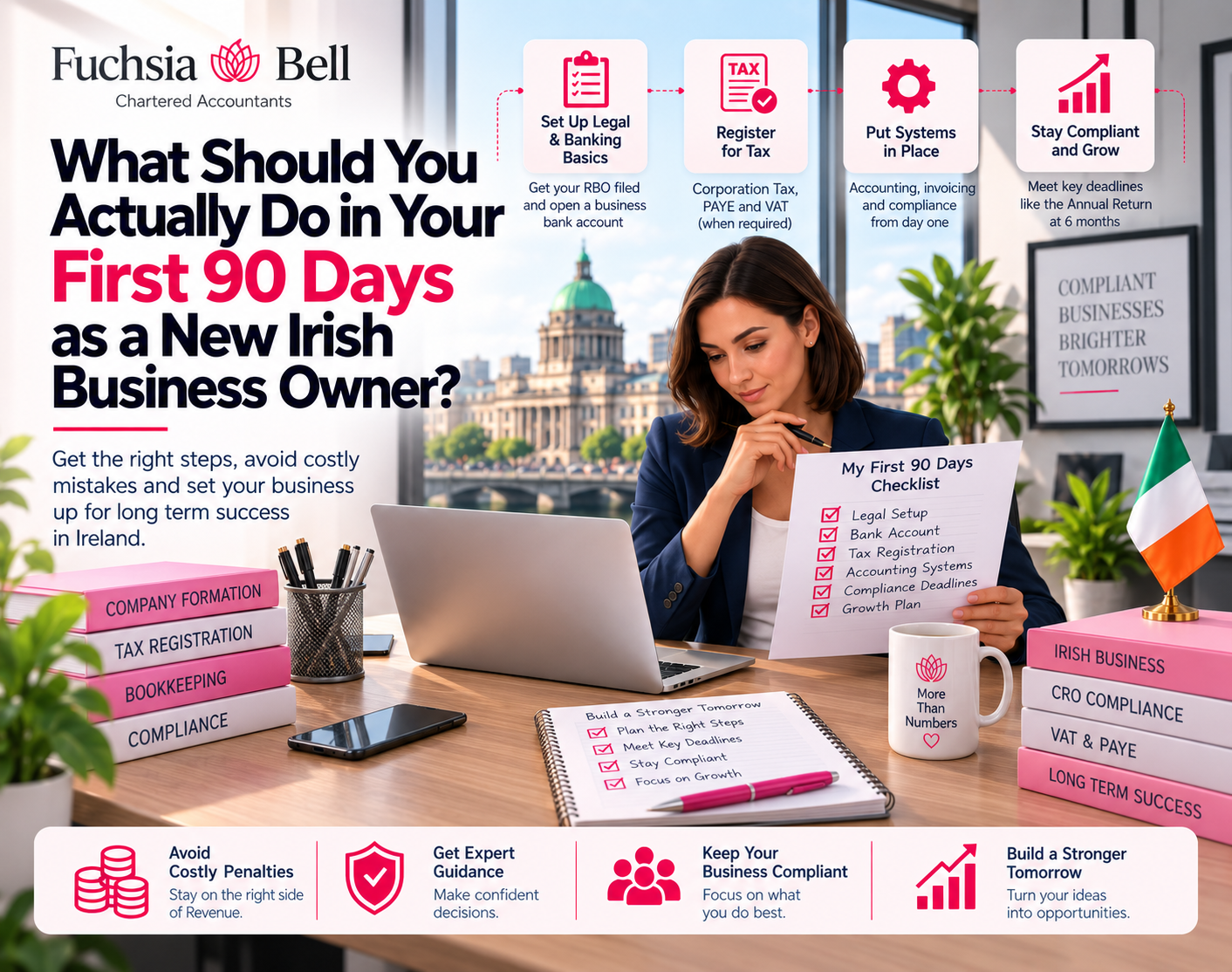
A Certificate of Incorporation from the CRO means your company legally exists. It does not mean you can trade, hire, or issue a valid invoice. Registering with Revenue for tax is a completely separate process, and the gap between these two steps is where a large share of new founders in Ireland lose their first few weeks without realising anything is missing.
The first 90 days follow a rough order: legal and banking foundations first, tax registration next, then the systems that keep the business compliant once it’s actually operating. Skipping the order rarely saves time. It just moves the problem to month four or five, when it’s harder to fix.
What Actually Happens in the First 14 Days
A business bank account in the company’s name, not a personal account, needs to exist before real trading starts. Most banks won’t finalise a business account without confirmation that the company has filed its Register of Beneficial Ownership return. Legally, RBO filing has a five-month window from incorporation. Practically, filing within the first two weeks avoids the account opening becoming the bottleneck for everything else, since nothing downstream, invoicing, VAT registration, payroll, works cleanly from a personal account.
This is also the point to get basic company secretarial services arrangements in place, since RBO, the statutory registers, and the company’s registered office all need to be correct before the first Annual Return comes due later.
Registering for Tax Isn’t Optional Once You Start Trading
Corporation tax registration with Revenue has to happen within 30 days of the company starting to trade, and Revenue’s definition of trading is broader than most founders assume. Making a product or service available for sale, including advertising it, counts as trading, even before the first invoice goes out. Waiting for the first sale to register is a common and costly misreading of the rule.
If the company will employ anyone, including a director taking a salary, PAYE registration needs to happen at the same time. VAT registration depends on turnover rather than a fixed deadline, covered separately below. Getting corporation tax registration done inside the 30-day window, rather than treating it as something to get to eventually, is the single most time-sensitive item in this whole period.
The Substance Question Revenue Is Now Asking
Revenue has tightened scrutiny of Irish companies with no real operational presence in the country, sometimes called brass plate companies, an address and a director but nothing else happening on the ground. A tax registration application in 2026 is more likely to be questioned if it can’t show evidence of genuine Irish activity: a real trading premises, local commercial contracts, an Irish bank account actually in use, or Irish-based directors and employees. A virtual office address on its own is increasingly not treated as sufficient proof of substance.
For a genuine start-up operating from Ireland, this rarely causes a problem. It matters most for founders structuring around a virtual presence without much happening locally, where the registration itself can now take longer or face additional questions.
Separating Business From Day One
Running business income and expenses through a personal account creates a mess that eventually has to be untangled at year-end, usually at greater expense than setting things up correctly from the start. A dedicated business account, connected to proper bookkeeping software rather than a spreadsheet, keeps every transaction traceable from the first week, not reconstructed months later from bank statements and memory.
The VAT Threshold Most New Founders Aren’t Watching Yet
VAT registration becomes mandatory once turnover crosses €42,500 for services or €85,000 for goods within any 12-month period, not a calendar year. A business growing quickly can cross that line well before its first year-end, and the obligation to register starts the moment the threshold is passed, not at the next convenient review point. Voluntary VAT registration before hitting the threshold is sometimes worth considering too, particularly for a business whose customers are mostly other VAT-registered companies able to reclaim the VAT charged.
What’s Waiting at Month Six
The first Annual Return, Form B1, is due exactly six months after incorporation and doesn’t require financial statements at that stage. It’s easy to miss precisely because it lands so early, before most founders have settled into any kind of routine, and before the business has produced its first set of accounts. Missing it triggers a penalty and, if ignored long enough, puts the company on a path toward being struck off the register entirely.
Frequently Asked Questions
Do I need to register for tax if the company isn’t trading yet?
Corporation tax registration is generally still expected even for a company that isn’t actively trading, since Revenue treats incorporation and dormancy as a compliance position that still needs to be declared, not an exemption from registering at all.
Can I use my home address as the registered office?
Yes, provided it’s a real Irish address where post can reliably be received, though many founders prefer a separate registered office address for privacy once the business becomes more publicly visible.
What happens if I miss the 30-day corporation tax registration window?
Late registration can trigger penalties and generally doesn’t reset the 30-day clock, so the obligation and any associated risk continue accruing from the original trading start date, not from whenever registration actually happens.
Does a sole trader follow the same 90-day sequence?
Not exactly. A sole trader registers directly with Revenue rather than going through the CRO first, so the sequence is shorter, but tax registration timing and the same substance expectations still apply.
Is a company seal still required?
A seal isn’t legally mandatory for most private companies anymore, but it’s still commonly used for certain official documents and share certificates, so many new companies obtain one regardless.
Building the First 90 Days Around the Actual Deadlines
The founders who get through this period smoothly aren’t the ones working faster. They’re the ones who know the CRO certificate and the Revenue registration are two separate finish lines, that the 30-day trading clock starts the moment a product goes on sale rather than when it’s first bought, and that month six brings a real filing deadline whether the business feels ready for it or not. Structuring the first 90 days around those actual dates, rather than a generic to-do list, is what keeps a new company out of its first avoidable penalty.
A broader look at structuring a new Irish business for tax efficiency from the outset is covered on geroconnor.info, and a fuller picture of how online chartered accountants work with founders in their first year is covered there too.