
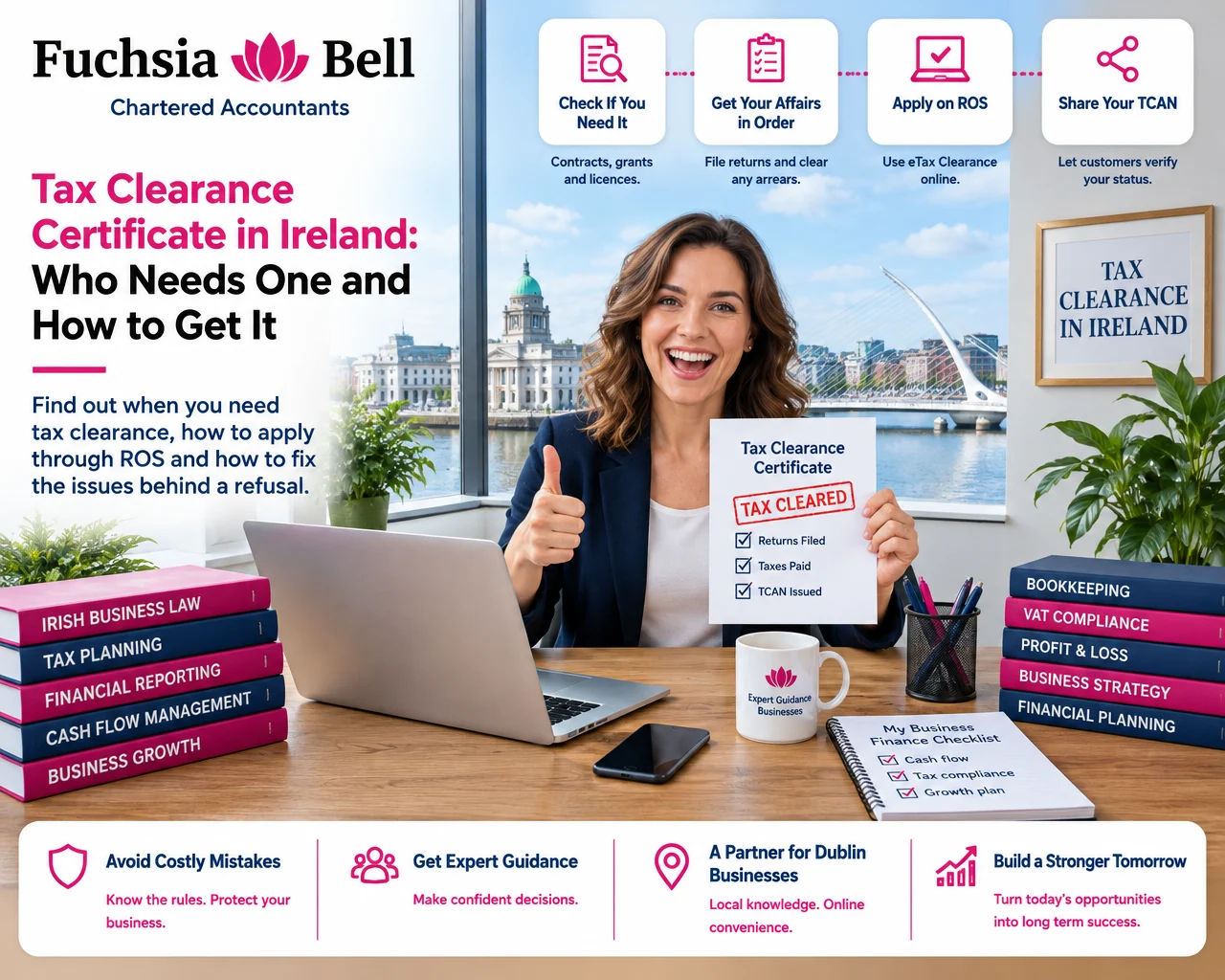
A Tax Clearance Certificate is Revenue’s confirmation that your tax affairs are in order on the date it is issued. Irish businesses most often need one to win public sector contracts worth €10,000 or more (including VAT) in any 12 months, to receive State grants or subsidies of €10,000 or more, and to apply for or renew certain licences, such as liquor, gaming and taxi licences. You apply online through Revenue’s eTax Clearance service in ROS, or in myAccount if you are a PAYE employee. If everything is up to date, you get a Tax Clearance Access Number (TCAN) that customers use to check your status. If it is not, the application is refused and Revenue tells you why.
Key takeaways on tax clearance in Ireland
- Tax clearance is required for public sector contracts and for State grants and subsidies of €10,000 or more in any 12-month period, and for a range of licences.
- You apply through eTax Clearance in ROS (businesses and the self-employed) or myAccount (PAYE employees). There is no fee.
- Revenue checks your own tax affairs and those of connected parties, such as the directors of a company.
- Your certificate stays valid while you remain compliant, but Revenue keeps checking and can withdraw it.
- Most refusals come from a missing return or an unpaid balance, often an old or “nil” return that nobody filed.
What is a Tax Clearance Certificate?
It is a statement from Revenue that, at the date of issue, you have filed your returns and paid, or agreed to pay, your taxes. It is not a one-off check. Under the electronic system, Revenue continues to monitor your compliance after the certificate issues, and your status can change if a return is missed or a payment falls behind.
You can see your current status at any time in ROS, where it is displayed near the top of the “My Services” page.
When do Irish businesses need tax clearance?
The main triggers are set out in the Taxes Consolidation Act and in Department of Finance circulars 43/2006 and 44/2006:
- Public sector contracts. A contractor needs tax clearance for a public sector contract worth €10,000 or more, including VAT, in any 12-month period. That applies to suppliers to Government departments, local authorities, the HSE, universities and other public bodies, and it applies even without a formal written contract. Subcontractors on those contracts can be asked for it too.
- Grants and subsidies. Payments of €10,000 or more in any 12 months from State or public bodies, including industrial and farm development grants, require tax clearance.
- Licences. Tax clearance is a condition of applying for or renewing a range of licences, including liquor licences, gaming licences and small public service vehicle (taxi and hackney) licences.
Beyond the legal requirements, private customers, banks and landlords increasingly ask for tax clearance as part of their own checks. Registered charities with a CHY number do not need it for grants, but they do for public contracts.
How do you apply through eTax Clearance?
- Get your own affairs in order first. Every return that is due should be filed, and every tax paid or covered by an agreed arrangement. That includes income tax or corporation tax, VAT, employer PAYE, Relevant Contracts Tax and Local Property Tax.
- Check your connected parties. Revenue reviews the affairs of people connected to the applicant. For a company, that means its directors, among others. Have their tax reference numbers, or property IDs for LPT, to hand.
- Apply online. In ROS, go to “My Services” and choose “Manage Tax Clearance”. If you are a PAYE employee, go to “Manage My Record” in myAccount and choose “Tax Clearance”.
- Read the result. If clearance is granted, you get your TCAN on screen and can print or save the certificate through “View, Print, Save”. If it is refused, the result lists the issues to resolve.
- Fix and reapply. Once the issues are dealt with, you submit a new application.
Non-resident persons who are not registered for Irish tax cannot use eTax Clearance and apply on paper using Form TC1. If you are selling Irish property as a non-resident, the separate CGT clearance rules apply, which I cover in tax clearance for non-residents in Ireland.
How do customers verify your tax clearance?
You give them your TCAN together with your tax reference number or PPSN. They can then check your status online through Revenue’s verification service, and public bodies with many suppliers can check them in bulk. You do not need to post or email the certificate itself, although many tender documents still ask for a copy.
How long does tax clearance last?
Your certificate remains valid for as long as you stay compliant. The application behind it expires, though: Revenue states that a grant application expires after one year and all other applications expire within four years. After that, you need to apply again. If you fall out of compliance in the meantime, Revenue can withdraw your clearance, and anyone checking your TCAN will see that.
Why is tax clearance refused, and how do you fix it?
| Reason for refusal | How to fix it |
|---|---|
| A return was never filed, sometimes years ago | File it. Check for VAT or payroll registrations that expect “nil” returns |
| A balance is unpaid | Pay it, or agree a phased payment arrangement and keep to it |
| A missed instalment on an existing arrangement | Bring the arrangement up to date and contact Revenue |
| A director’s personal tax is not in order | The director files and pays, then the company reapplies |
| Local Property Tax is outstanding | File the LPT return and pay or set up a deduction |
| An old registration is still open | Cease registrations you no longer need in ROS |
The registration point is the one I see most. A company registers for VAT or as an employer, stops using it, and never cancels it. Here is how to cancel a VAT registration properly. Revenue’s system keeps expecting returns, and when none arrive, clearance is refused.
Can you get tax clearance with a payment arrangement?
Yes. If you cannot pay a balance in full, Revenue can agree a phased payment arrangement. Where one is in place and you keep up the instalments, tax clearance can still be granted. Missing an instalment is one of the quickest ways to lose it.
Tax clearance checklist: what to check before you apply
Most applications that are refused could have been approved first time. Before you apply for a tax clearance certificate in ROS, work through this checklist for your business and for anyone connected to it:
- Income tax or corporation tax: every Form 11 or CT1 that is due has been filed, and the tax paid.
- Preliminary tax: paid for the current year by the due date.
- VAT: every VAT return filed, including “nil” returns for quiet periods.
- Employer PAYE: payroll submissions and monthly or quarterly payments up to date.
- Relevant Contracts Tax: RCT returns and payments up to date if you are a principal contractor.
- Local Property Tax: returns filed and payments up to date on any residential property you own.
- Directors: each director’s own Form 11 filed and tax paid.
- Payment arrangements: every instalment paid on time.
- Old registrations: any tax registration you no longer use has been cancelled in ROS.
If every box is ticked, the online application is often dealt with quickly. If one is not, fix it first: a refusal will simply list the same issues back to you.
Tax clearance for new businesses and new companies
A new business can get tax clearance as soon as it is registered for the taxes that apply to it, because there are no overdue returns to check yet. Revenue will still look at connected parties, so a new company can be refused because of a director’s own unfiled return or unpaid tax. If you are about to tender for your first public contract, register for tax early, apply straight away and keep the certificate in good standing from day one. New companies should also check whether they qualify for corporation tax relief for start-up companies in their first years of trading.
What I see with businesses in Dublin, Cork and Kerry
In Dublin and Cork, the urgent calls come from contractors and IT consultants who have just been offered work with a public body and need tax clearance before the first invoice can be paid. A university or the HSE will not pay without it. In Kerry, it is more often tourism and hospitality businesses and farms applying for grants, and pubs renewing their licences. The fix is rarely complicated, but it takes time if a return from two or three years ago is missing. If your company is behind on its corporation tax returns, start with what happens if your company never files a CT1.
Getting tax clearance in place before you need it
Do not wait for the tender deadline. Log in to ROS now, check your status and, if it says you are not tax compliant, find out why while there is time to fix it. If your returns need catching up, I can help you get them filed and the application through. You can book a free 30-minute business check with me at Fuchsia Bell.
Related guides on Revenue compliance
- Missed the tax return deadline in Ireland? What to do now
- What happens if your company never files a CT1
- What happens during a Revenue audit in Ireland
- What expenses can a sole trader claim in Ireland?
- Voluntary VAT registration in Ireland
FAQ About Tax Clearance Certificates in Ireland
How long does it take to get a Tax Clearance Certificate?
If your affairs, and those of your connected parties, are fully up to date, the online application is often dealt with quickly. If there are outstanding issues, it takes as long as it takes to fix them, which is why it is worth checking well before you need it.
Does a Tax Clearance Certificate cost anything?
No. Revenue does not charge a fee for tax clearance.
Do sole traders need tax clearance?
They need it in the same situations as companies: public sector contracts, State grants and certain licences. A sole trader applies through ROS in the same way.
Can I check my tax clearance status myself?
Yes. Your status is shown in ROS, and you can also print or save a current certificate there.
What if my company is refused because of a director’s personal tax?
The director needs to bring their own returns and payments up to date first. Once that is done, the company can reapply. This is common where a director has rental income or a late Form 11, which I cover in what to do if you missed the tax return deadline.
How long is a tax clearance certificate valid in Ireland?
It stays valid for as long as you remain tax compliant, and Revenue keeps checking. The application behind it does expire: a grant application after one year and other applications within four years, after which you apply again.
What is a TCAN?
A TCAN is the Tax Clearance Access Number Revenue gives you when clearance is granted. You give it to a customer or public body together with your tax reference number or PPSN, and they use it to check your status online.
Can a new company get tax clearance?
Yes. Once the company is registered for the relevant taxes and nothing is overdue, it can apply. Revenue also checks connected parties, so each director’s own tax affairs need to be in order.
Why does ROS say I am not tax compliant?
Usually because a return is missing or a payment is overdue, often an old VAT or payroll “nil” return, a director’s Form 11, or Local Property Tax. When you apply, ROS lists the specific issues to resolve.