
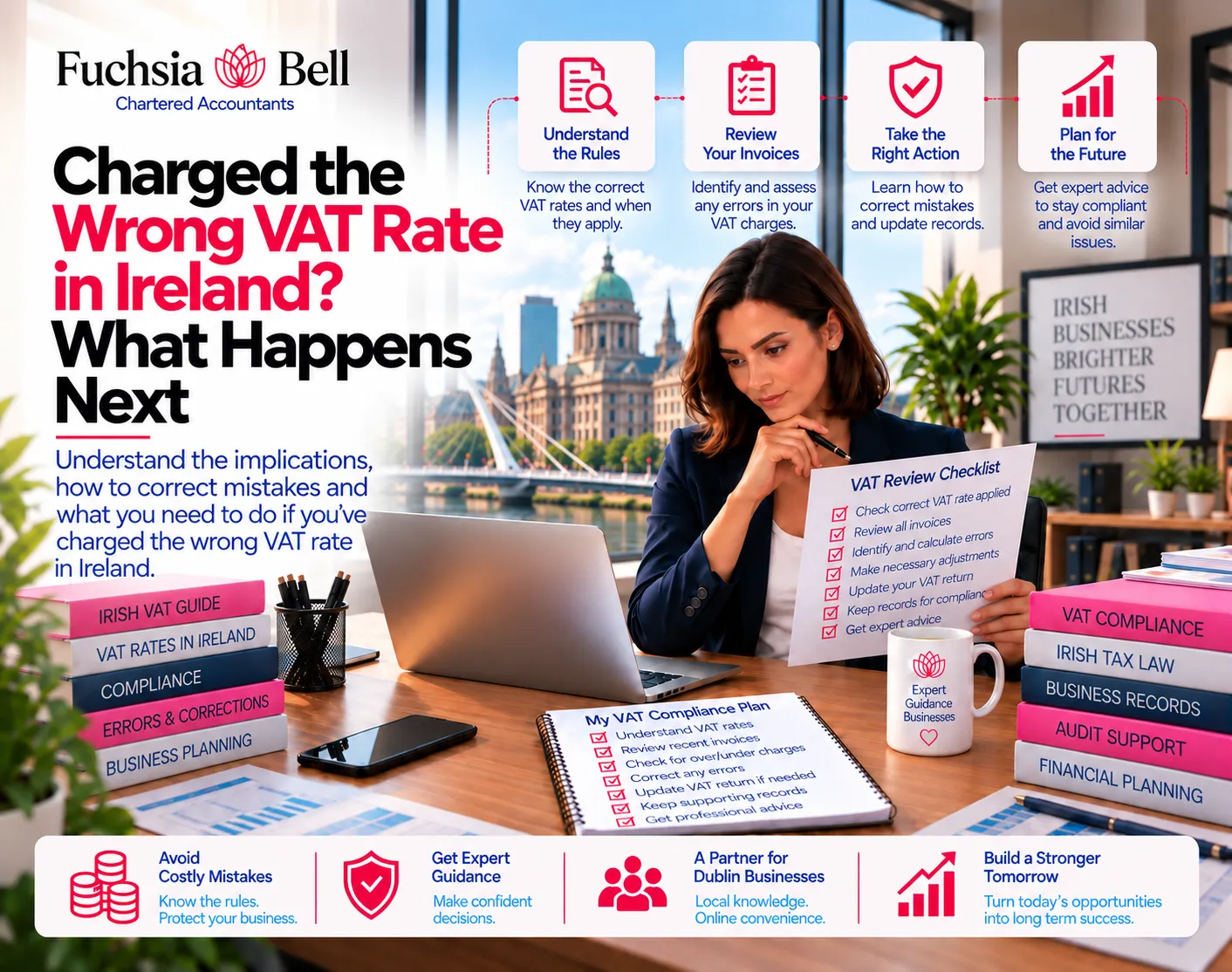
A question I get a lot goes something like this: “I have been charging 13.5% and I think it should have been 23%. How bad is this?” If you have charged the wrong VAT rate in Ireland, it is usually fixable, and the fix depends on which way the mistake went. Here is how I would handle it, with the current 2026 rates, Revenue’s rules on credit notes and revised invoices, and when it is time to tell Revenue.
Key takeaways
- Ireland’s VAT rates in 2026 are 23% standard, 13.5% reduced, 9% second reduced, 4.8% for livestock and 0% zero rate.
- From 1 July 2026, restaurant and catering food, hot takeaway food and drink, and hairdressing moved from 13.5% to 9%.
- If you showed too much VAT on an invoice, Revenue says you are still liable for it until you issue a credit note and a revised invoice.
- If you showed too little, Revenue says to cancel the invoice in full with a credit note and issue a new one with the correct VAT.
- Small net errors can often be corrected on a later VAT3; bigger or older ones are better handled through a qualifying disclosure.
What are the VAT rates in Ireland in 2026?
The standard VAT rate in Ireland is 23%. The reduced rate is 13.5%, the second reduced rate is 9%, livestock is 4.8% and the zero rate is 0%. From 1 July 2026, restaurant and catering food, hot takeaway food and drink, and hairdressing moved from 13.5% to 9%.
| Rate | Typical examples (as of October 2026) |
|---|---|
| 23% | Cars, electronics, alcohol, petrol, furniture, soft drinks |
| 13.5% | Construction, cleaning, vet fees, heating oil, hotel accommodation |
| 9% | Gas and electricity, EV charging, gym subscriptions, restaurant and catering food, hairdressing |
| 4.8% | Live cattle, sheep and pigs, for specific agricultural transactions |
| 0% | Most basic food, children’s clothing and footwear, oral medicines, books |
The July change is where I would expect many of this year’s mistakes. A Dublin café or salon whose invoicing software was still set to 13.5% after 1 July may be overcharging every customer. Check the rate on your invoice template first, then look at how it flowed into your VAT returns.
What happens if you have charged the wrong VAT rate in Ireland?
It depends on which way the mistake went. Too much VAT means you owe Revenue the amount shown until you issue a credit note and a revised invoice. Too little means cancelling the invoice with a credit note and reissuing it. Either way, the correct VAT is what Revenue expects.
What if you charged too much VAT?
If you showed too much VAT on an invoice, you are still liable to Revenue for the VAT shown. To put it right, issue a credit note and a revised invoice with the correct rate. Fixing only the next invoice does not correct the first one, so the original needs to be dealt with properly.
Take a catering invoice of €2,000 plus VAT, issued to a business customer after 1 July 2026. At 13.5% the VAT shown is €270. At the correct 9% it should be €180. That is €90 too much. Until you issue the credit note and revised invoice, you owe Revenue the €270, and your customer may have claimed €270 back on their own VAT return. Fixing the paper puts both of you right.
You can read Revenue’s own words in its guidance on amending a VAT invoice. In short: overcharged VAT is your liability until the credit note is issued.
What if you charged too little VAT?
If you showed too little VAT, Revenue says to cancel the invoice in full with a credit note and then issue a revised invoice showing the correct VAT. The VAT is still due to Revenue at the right rate, whether or not you can collect the extra from your customer.
Say you sold furniture worth €10,000 plus VAT at 13.5% when 23% applied. The VAT shown is €1,350, the VAT due is €2,300 and the gap is €950. Whether you can collect that €950 from the customer depends on what you agreed. If the price was agreed as VAT-inclusive, you may end up carrying the cost yourself. That is a conversation to have before the revised invoice goes out, not after.
For ongoing corrections, your VAT 3 return is where the adjustment ends up, so keep a note of each fix as you make it.
Do you have to tell Revenue about a VAT mistake?
Usually you correct it through your VAT returns, and in more serious cases you make a qualifying disclosure to Revenue. As a general rule, a net underpayment of less than €6,000 can often be corrected on a later VAT3. Bigger or older errors are better handled with advice before Revenue raises them.
A qualifying disclosure is a written disclosure of the error, with payment of the VAT due and interest, made before Revenue begins an audit or investigation. Unprompted disclosures attract lower penalties than prompted ones. For context, Revenue’s penalty for incorrect VAT records is €3,000 for careless behaviour and €5,000 for deliberate behaviour, so putting things right early is worth the effort. Interest on late VAT runs at 0.0219% a day.
The honest answer on the €6,000 figure is that it is a rule of thumb. The right route depends on the periods involved, whether the mistake was one-off or repeated, and the size of the net figure.
How do you stop it happening again?
Check the rate when you set up each product or service, and again whenever rates change. Keep a note of the rate you chose and why. Review a few invoices every month against your VAT3 totals. Good bookkeeping catches mistakes early.
If you are new to VAT, the right rate starts at set-up, and our guide on how to register for VAT in Ireland shows what to put in place first.
A Galway business selling a mix of 23% and 13.5% items needs each line coded correctly, because a single wrong default can repeat itself for months. Good bookkeeping catches it quickly: a quick monthly review of sales by VAT rate would have flagged most of the mistakes I come across. If a product could sit in two categories, ask Revenue or your accountant before you invoice it.
Getting help with VAT in Dublin, Galway and across Ireland
I’m Gero O’Connor, a chartered accountant, and I run Fuchsia Bell in Castlemaine, Co. Kerry. We work with clients in Dublin, Galway, Mayo and right across Ireland, online. If you are in Dublin, our VAT services in Dublin cover corrections and returns. In the west, a chartered accountant in Galway can review your invoices fully online.
Frequently Asked Questions
What is the standard VAT rate in Ireland in 2026?
The standard VAT rate in Ireland is 23%. It applies to most goods and services, such as cars, electronics, alcohol, petrol, furniture and soft drinks. Other rates include 13.5%, 9%, 4.8% for livestock and 0% for items such as most basic food and children’s clothing.
Did the VAT rate for restaurants change in 2026?
Yes. From 1 July 2026, restaurant and catering food, hot takeaway food and drink, and hairdressing moved from 13.5% to 9%. Hotel accommodation stays at 13.5%, so only the food and catering element of a hotel stay is affected. Alcohol and soft drinks stay at 23%.
Can I just fix the VAT on my next invoice?
No. Revenue expects the original invoice to be corrected with a credit note and a revised invoice. Changing the rate on your next invoice leaves the first one wrong, and your VAT return and your customer’s will both be out.
What is the penalty for incorrect VAT records?
Revenue’s penalty for incorrect VAT records is €3,000 for careless behaviour and €5,000 for deliberate behaviour. Putting things right early, ideally through a qualifying disclosure before Revenue starts an audit, usually reduces what Revenue seeks, so do not sit on a mistake once you have spotted it.
Where do I check which VAT rate applies?
Use the VAT rates search on Revenue.ie to check a product or service. If it sits between two categories, ask Revenue or your accountant before you invoice it. Getting the rate right once is far easier than correcting a year of invoices later.
If your situation is a bit messier than the examples above, talking it through with a chartered accountant can usually sort it out in one conversation. Send me the details, and I will tell you which way the error went, what it costs and how to put it right.
Related guides on tax and Revenue
- Why Do Some Irish Businesses Choose to Register for VAT Before They Have To?
- What Actually Happens During a Revenue Audit in Ireland?
- Why Do So Many Small Businesses Still Lose Receipts Before Tax Season?
- Bookkeeping Software vs a Real Bookkeeper: What Dublin & Cork Small Businesses Actually Need
If you would rather have this handled for you, see our tax and Revenue services or book a free 30-minute business check.