
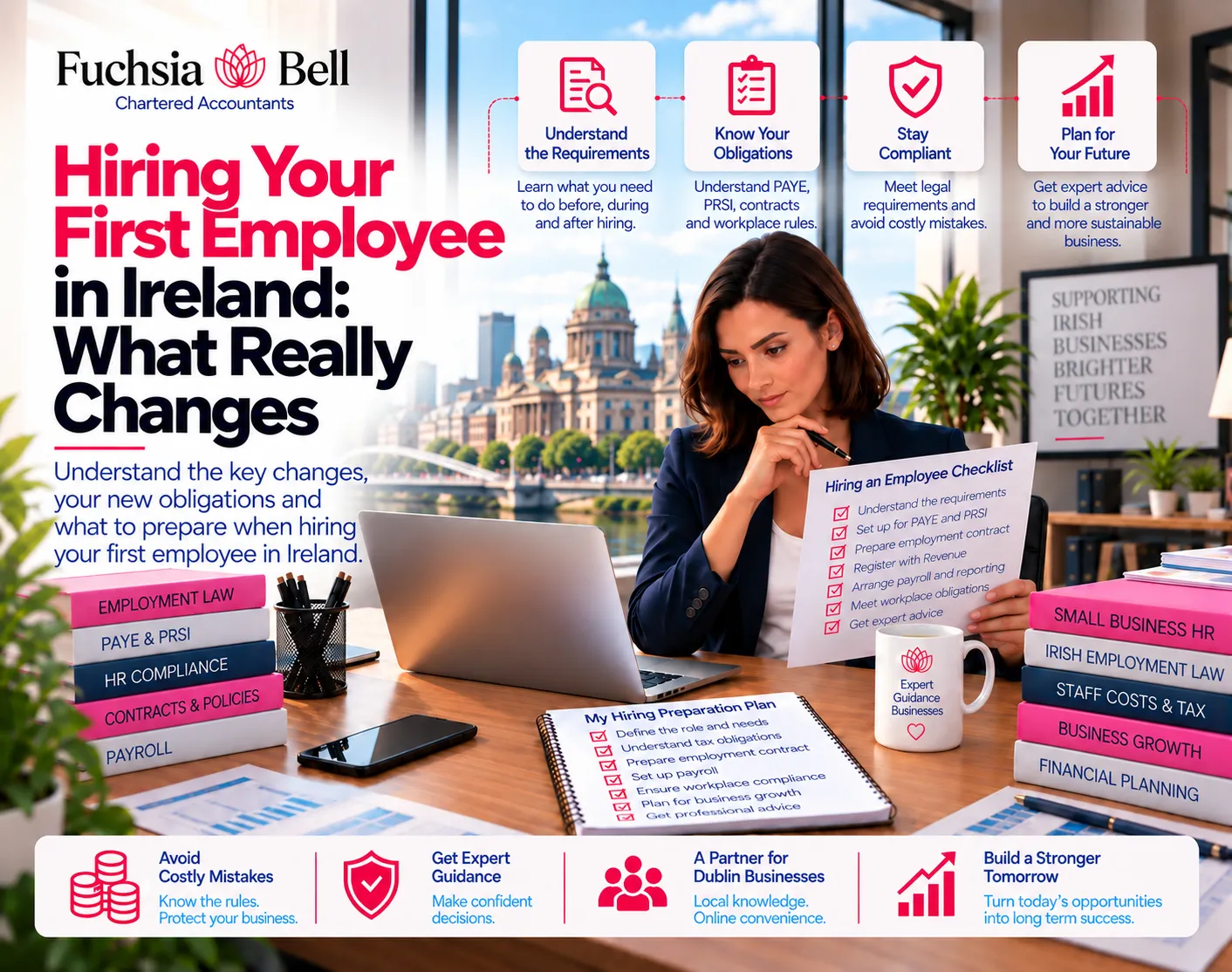
A question I get a lot is: “I am busy enough to take someone on. What actually changes?” The short answer is that hiring your first employee in Ireland makes you an employer. You register with Revenue, run PAYE, USC and PRSI through payroll, pay at least the minimum wage and, from 2026, you may have to enrol your new hire in My Future Fund. This post covers what changes, what it costs on top of salary and the order I would do it in.
Key takeaways
- You must register as an employer with Revenue before you pay anyone, using MyEnquiries in ROS.
- You report pay and deductions to Revenue on or before each payday.
- From 1 October 2026, employer PRSI is 9.15% on weekly pay up to €552 and 11.4% above that.
- The minimum wage is €14.15 an hour in 2026, rising to €14.94 on 1 January 2027.
- On a €35,000 salary, employer PRSI and My Future Fund add about €4,515 a year on top of the pay.
What do you need to do before hiring your first employee in Ireland?
Register as an employer with Revenue before you pay anyone, using the MyEnquiries tab in ROS. You then deduct Income Tax, PRSI and USC from each pay and report them to Revenue on or before the pay date. You also need written terms and a payslip for every payment.
Here is the order I would follow:
- Register as an employer on ROS through MyEnquiries. A company must also register for PAYE to pay its directors, even with no other staff.
- Collect your new employee’s PPS number and start date, and find out whether this is their first job in Ireland.
- Put the core terms of employment in writing. The normal rule is within five days of starting.
- Set up payroll software and the employee’s pay, using the tax details Revenue sends you for them.
- Pay at least the minimum wage and give a payslip with every payment.
- Run payroll and submit it to Revenue on or before the pay date.
- Pay the PAYE, PRSI and USC to Revenue by the 14th of the following month, or the 23rd if you pay through ROS.
- Check whether the employee must be enrolled in My Future Fund.
According to Revenue’s employer registration guidance, the registration step has to come first. Getting it in the wrong order is the most common first-hire mistake I see. A Dublin start-up that has agreed a start date with a developer but not registered has already put the first payday at risk.
How much does employer PRSI cost?
Employer PRSI is 9.15% on weekly pay up to €552 and 11.4% on weekly pay above that, from 1 October 2026. The rate depends on the weekly pay band. Budget 2027 raises the lower-rate threshold to €600 a week and lifts both rates again from 1 October 2027.
Employer PRSI is the cost most first-time employers forget to include. Here is a worked example on a €35,000 salary, which is about €673 a week:
| Cost | Rate | Annual amount |
|---|---|---|
| Gross salary | €35,000 | |
| Employer PRSI | 11.4% | €3,990 |
| My Future Fund employer contribution | 1.5% | €525 |
| Extra cost on top of salary | €4,515 | |
| Total cost of the hire | €39,515 |
That is before holiday pay, sick pay, insurance and any pension beyond My Future Fund. The employee’s own PAYE, USC and PRSI come out of their pay and do not add to your cost. The rate is due to rise again in October 2027, so budget for that too.
What is the minimum wage when hiring in Ireland?
The national minimum wage is €14.15 an hour in 2026 and rises by 79 cent to €14.94 an hour from 1 January 2027. Some sectors have different rates. Underpaying can bring a fine of up to €2,500 or up to six months in prison, and serious cases can go to €12,697.38 or three years.
Those penalties come from Citizens Information’s guidance on employing people, and they are why I would always work out the hourly rate from the full contracted hours before you advertise. If you are hiring a part-time worker for a café in Galway or a van driver in Mayo, the same rate applies. The rules are national.
Do you have to enrol staff in My Future Fund?
Yes, if the employee is eligible. Employees aged 23 to 60 earning €20,000 or more across all jobs, and not already paying into a pension through payroll, are auto-enrolled. In years one to three the employee pays 1.5%, you pay 1.5% and the State adds 0.5%.
If you have an eligible employee, you will need to register on the employer portal and run the contributions through payroll. Our My Future Fund employer guide explains the rules. The walkthrough of the employer portal takes you through registration step by step. Employers who do not meet their obligations face penalties, including fines and prosecution.
You do not have to offer an occupational pension, but eligible staff must be auto-enrolled whether or not you run a scheme of your own.
Should you run payroll yourself or get help?
For one employee, you can run payroll yourself with payroll software, and plenty of small employers do. The risk is not the first payslip but the thirtieth, when a rate changes or a submission goes in late. If your time is worth more than the cost of help, hand it over.
My rule of thumb is simple. If your payroll takes you more than an hour a month, or you are not sure you have it right, price outside help against your own time. A small payroll service for one or two people is usually modest, and it is easier to start clean than to fix a year of submissions. Dublin employers can use payroll services in Dublin, which is the same service delivered online.
Getting help with your first hire in Dublin, Galway and across Ireland
I’m Gero O’Connor, a chartered accountant, and I run Fuchsia Bell in Castlemaine, Co. Kerry. We work with new employers and small business owners in Dublin, Galway, Mayo and right across Ireland, online. A chartered accountant in Galway can set up your first payroll without you needing to be in the same room.
Frequently Asked Questions
Do I need to register as an employer if I only hire one person?
Yes. You must register as an employer with Revenue before you pay your first employee, through MyEnquiries in ROS. The only exception is a single domestic employee paid less than €40 a week. A company must also register to pay its directors through PAYE.
What is the employer PRSI rate in Ireland in 2026?
From 1 October 2026, employer PRSI is 9.15% on weekly pay up to €552 and 11.4% on weekly pay above that. Both rates rise again from 1 October 2027, to 9.30% and 11.55%, and the lower-rate threshold rises to €600 a week.
Do I have to offer a pension to my first employee?
You do not have to offer an occupational pension. However, eligible employees must be auto-enrolled in My Future Fund. That means employees aged 23 to 60 earning €20,000 or more across all jobs and not already paying into a pension through payroll.
How do I report payroll to Revenue?
You submit payroll to Revenue through your payroll software, on or before the date you pay your employee. The submission shows the pay and the deductions. If you find an error later, you correct it using Revenue’s payroll correction rules as soon as you spot it.
When do I pay PAYE to Revenue?
You pay the PAYE, PRSI and USC you have deducted by the 14th of the month after the pay month. If you pay through ROS, the date is extended to the 23rd. Late payment can attract interest, so set a reminder for each month.
If your situation is a bit messier than the examples above, talking it through with a chartered accountant can usually sort it out in one conversation. Send me the details of the role and the pay, and I will tell you what the hire will really cost and what to set up first.
Related guides for employers
- Why Do Irish Employers Get Payroll Wrong in Their First Year of Hiring?
- What Happens If You Pay an Employee Late in Ireland?
- Tax-Free Christmas Bonus for Staff in Ireland: The €1,500 Rule
- Employing Your Spouse in Ireland: Tax Savings, Credits and PRSI
If you would rather have this handled for you, see our payroll and employer services or book a free 30-minute business check.