
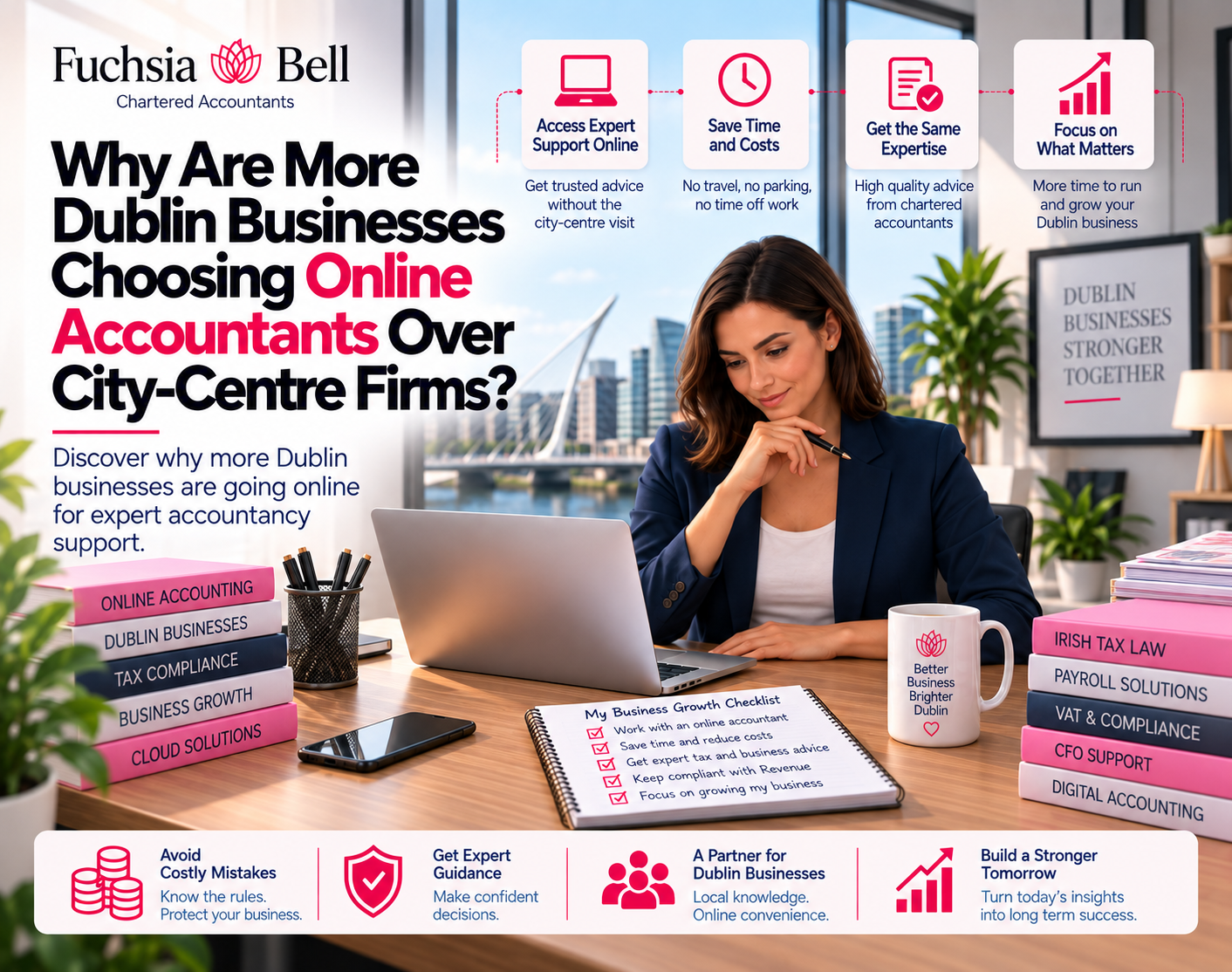
It is not just a cost question, though the cost difference is part of it. The shift among Dublin businesses towards online accountancy firms has been driven by owners who realised that the work they were travelling to Baggot Street or Ballsbridge for could be done just as well, in many cases better, through a shared screen and a cloud accounting platform. The assumption that your accountant needs to be a short walk away has quietly stopped being true for most small and medium-sized businesses in the capital.
The Practical Case for Online Accounting
The core function of an accountant does not require physical proximity. Filing returns with Revenue, preparing financial statements, running payroll, handling VAT returns, providing tax advice: all of it can be done remotely using the same software, the same Revenue Online Service access, and the same level of professional qualification as any city-centre practice. What changed over the past five years is that the tools became significantly better, businesses became more comfortable with remote professional services, and the price difference between a city-centre firm and a well-run online practice became much harder to justify.
What Changed for Dublin Businesses After 2020?
The pandemic forced a practical experiment most businesses would not have chosen voluntarily. Accountants switched to video calls and shared documents, clients uploaded receipts through apps, and VAT returns and payroll ran on schedule without anyone sitting in a meeting room. Many Dublin business owners discovered during that period that the in-person element of their accountancy relationship was largely ceremonial. Businesses now searching for Dublin accountants are asking very different questions to five years ago, specifically about cloud access, response times, and fixed fees rather than office location.
Are Online Accountants as Good as Traditional Firms?
Qualification level and quality of service are not determined by geography. A chartered accountant with the same professional body membership, the same knowledge of Revenue rules, and the same ROS access is equally capable of handling the work whether based in Kerry or a city-centre office in Dublin 2. What varies between firms is not online versus in-person but depth of knowledge, responsiveness, and how well they understand the specific industry and structure of your business. The right question is not where the accountant sits. It is whether they know your type of business and answer their phone.
What Services Work Fully Online?
Bookkeeping, VAT returns, payroll, corporation tax filings, income tax returns for directors and sole traders, year-end accounts, Revenue correspondence, ROS filings, and company secretarial work all run cleanly through cloud platforms and secure document sharing. The one area where in-person still has a genuine advantage is complex structuring decisions where the business owner needs to work through major choices in real time. For ongoing compliance and filing work, which is the majority of what most small businesses need from an accountant, remote delivery is functionally identical to sitting across a desk.
The Cost Difference Between Online and City-Centre
City-centre Dublin firms carry significant overhead: office rent, rates, reception staff, and meeting room costs. Those costs feed into the fee structure, often without the client explicitly seeing them broken out. An online firm with lower fixed costs can price the same scope of work more competitively, or put the difference into faster turnaround and more regular contact. Not every online firm is cheaper and not every city-centre firm is overpriced, but the structural overhead gap is real and tends to show up when fees are compared side by side. For a Dublin business paying premium fees for work already done remotely by their existing firm, the comparison is worth making.
How Cloud Accounting Changes the Relationship
Platforms like Xero, Sage, and QuickBooks allow a business owner and their accountant to look at the same live financial data at the same time from different locations. This changes the dynamic from an annual catch-up to an ongoing relationship where issues are flagged as they appear rather than discovered at year-end. For corporation tax planning in particular, seeing the liability build in real time through the year allows for informed decisions on director remuneration, pension contributions, and capital expenditure timing. Most Dublin businesses that switch to cloud accounting report they feel more in control of their finances, which is the opposite of what many expected before they made the change.
What to Look for When Choosing an Online Accountant
Professional qualification matters: look for Chartered, ACCA, or CPA designation and verify it through the relevant body. Industry experience matters: an accountant who has never dealt with your type of business is a risk regardless of their location. Responsiveness matters most: the main practical complaint about any accountant, in-person or remote, is that they are hard to reach when something urgent comes up. Ask specifically about how tax returns and Revenue queries are handled, what the turnaround commitment is, and whether there is a named person responsible for your account. Fixed monthly fees for a defined scope are generally more useful for an SME than hourly billing where the final cost is unpredictable.
Is It Right for Every Dublin Business?
For most small and medium-sized Dublin businesses doing between €150,000 and €5 million in turnover with standard compliance needs, online accountancy works well. The businesses where in-person still has a genuine advantage tend to be very early-stage, where founders need extensive guidance across decisions that are hard to work through remotely, or very large, where the complexity and volume of work require a more embedded relationship. For the majority of Dublin SMEs that fall between those two points, the question is really about finding the right firm, not the nearest one.
Frequently Asked Questions
Can an online accountant represent me in a Revenue audit?
Yes. Revenue audits are handled through correspondence and meetings that can take place by video call. An online accountant handles Revenue correspondence through ROS in the same way a city-centre firm does.
How do I share documents with an online accountant?
Most online practices use secure client portals or cloud storage. Bank statements, invoices, and payroll records are uploaded there rather than dropped off in person. The process is typically faster than physical delivery.
Does switching mean losing continuity on my accounts?
Not if the handover is managed properly. A new accountant can request prior year returns and accounts from Revenue directly if needed and can usually rebuild the full picture from existing records within a few weeks of onboarding.
Do online accountants work with Irish Revenue systems?
Yes. All Irish tax filings go through Revenue Online Service, which is an online platform regardless of where your accountant is based. Location has no bearing on ROS access or filing capability.
We Work With Dublin Businesses Across Every Sector
GEroConnor, in partnership with Fuchsia Bell, provides online accounting and tax services to businesses across Dublin and nationally. Whether it is VAT returns, payroll, year-end accounts, or income tax for company directors and sole traders, we handle it as part of a fixed monthly engagement so clients always know what they are paying and who to call.
See What Online Accountancy Looks Like in Practice
If you are currently paying for a city-centre accountancy relationship and are not certain you are getting full value from it, a conversation costs nothing. A full breakdown of what our services cover for Dublin SMEs is on our site, alongside a Dublin guide to what businesses in the capital should expect to pay and receive from a fully remote accountancy engagement.