
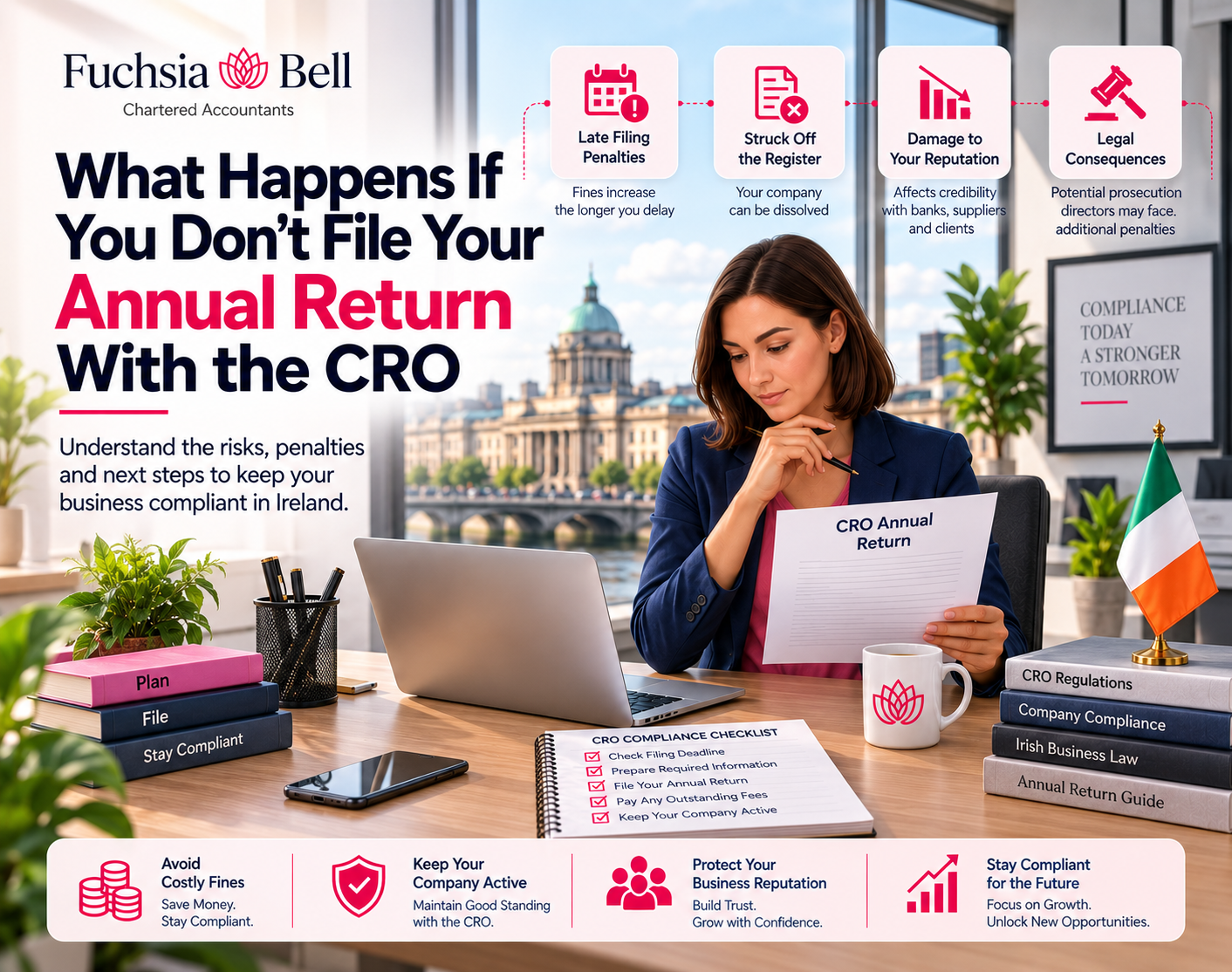
A missed Annual Return Date starts with an automatic €100 fine. Then €3 gets added for every day it stays unfiled, up to a maximum of €1,200. That’s the mild version. File late a second time within any five-year period and the company loses its audit exemption for the following two years, which typically costs an extra €2,000 to €3,000 annually in mandatory audit fees. Ignore it long enough and the Companies Registration Office starts the process of striking the company off the register entirely.
None of this requires the CRO to chase anyone down first. The obligation sits with the company from the moment it’s incorporated, and the penalties apply automatically once the 56-day filing window closes.
The 56-Day Window, and What €100 Plus €3 a Day Actually Adds Up To
Every Irish company has an Annual Return Date set by the CRO, usually six months after incorporation for the first return, then every 12 months after that. The filing deadline is 56 days from that date. Where financial statements need to be attached, the actual cutoff is whichever comes first: the Annual Return Date plus 56 days, or the financial year-end plus nine months and 56 days.
Run past that window and the €100 penalty applies immediately, with €3 added daily until it hits the €1,200 ceiling around day 367. It sounds manageable on paper. In practice, it’s rarely the fine itself that costs a company money. It’s what the fine signals to the CRO about the company’s compliance history.
The Real Cost Sits in Audit Exemption, Not the Fine
Losing audit exemption used to follow from a single missed deadline. That changed on 16 July 2025. Under Section 22 of the Companies (Corporate Governance, Enforcement and Regulatory Provisions) Act 2024, a small or micro company now loses its audit exemption only after filing late twice within a rolling five-year period, not automatically on the first slip. Late filings from before that date don’t count toward the test.
The first late filing is now survivable in a way it wasn’t before. The second one within that five-year window still costs two years of mandatory statutory audits, generally running €2,000 to €3,000 a year for a small company. Over two years, that’s an unplanned €4,000 to €6,000 that has nothing to do with the original late filing fee, and it follows the company through its next set of accounts regardless of how well it’s run in the meantime.
Getting financial statements ready alongside the return, rather than treating them as separate tasks, is usually what prevents a company from ever reaching that second late filing. Our annual accounts and CT returns work runs on the same calendar as the CRO deadline specifically to avoid this.
How Strike-Off Proceedings Actually Start
Persistent non-compliance moves the situation somewhere more serious. This escalates in stages, not all at once.
The 21-Day Notice
The CRO issues a notice to the company’s registered address once filings remain outstanding. From that point, there’s a 21-day window to respond and bring the filings current.
The Gazette Notice and the Final 28 Days
No response, and the CRO publishes a strike-off notice in the CRO Gazette, the official public record. That starts a final 28-day countdown. If the company still hasn’t filed by the end of it, the CRO proceeds with striking it off the register.
Enforcement around this has tightened since the Companies Act 2024 amendments took effect, and the CRO has been more active in following through on strike-off notices rather than letting them sit unresolved.
What Striking Off Actually Means
Once struck off, the company stops existing as a legal entity. It can no longer trade, hold assets, or enter contracts. Any assets it still holds vest in the state. Directors who keep operating the business as though nothing changed, issuing invoices, signing agreements, taking payments, can end up personally exposed for debts the now-dissolved company can’t legally incur.
Restoration is possible but not simple. Administrative restoration through the CRO is only available within 12 months of the strike-off date, and it requires every outstanding filing brought current along with all penalties paid before the CRO will process it. Beyond that 12-month window, restoration has to go through the courts instead, which takes considerably longer and costs considerably more.
Why “The Company Isn’t Trading” Doesn’t Exempt It
A common assumption among directors of shelf or dormant companies is that no activity means no filing obligation. That’s not correct. A dormant company still has an Annual Return Date, still faces the same 56-day window, and still accumulates the same penalties if it’s missed. It also usually still needs to submit a nil corporation tax return alongside its annual return, since corporation tax filing obligations run on their own separate clock from CRO compliance.
Newly incorporated companies run into a related version of this. The first Annual Return Date lands six months after incorporation, often before a founder has settled into any kind of routine for the business. Building that date into whatever setup process a new company goes through, alongside the rest of the start-up accounting basics, tends to prevent the very first filing from slipping.
Keeping the Two Filings Together
The annual return and the financial statements attached to it are technically separate documents, but they share a deadline and usually get prepared side by side. Handling both as one process rather than two separate deadlines is what actually keeps most companies inside the 56-day window without last-minute pressure. We file annual accounts online for clients alongside their CRO return so the two never end up out of sync.
Frequently Asked Questions
Can the CRO ever waive the late filing penalty?
Only in narrow circumstances such as force majeure, a documented bereavement, or proven non-delivery of documents sent by post. Independent evidence is required, and it’s the exception rather than something to plan around.
Does a dormant or non-trading company still need to file?
Yes. Trading status doesn’t affect the filing obligation. A dormant company follows the same 56-day window and faces the same penalty structure as an active one.
Can I change my Annual Return Date if it falls at an inconvenient time?
Yes, once every five years, using Form B73. This can help align the Annual Return Date with the company’s actual financial year-end rather than leaving it on an arbitrary date set at incorporation.
What happens to company debts if it gets struck off while still trading?
The company can no longer legally hold assets or enter contracts once struck off, and directors who continue operating it can face personal exposure for obligations the dissolved company can’t legally carry.
Is restoration guaranteed once penalties are paid?
Not automatically. Administrative restoration within 12 months requires every outstanding filing to be current and all fees paid before the CRO processes it. Past that window, restoration goes through the courts instead.
Getting Ahead of the Next Deadline
Most companies that end up in strike-off proceedings didn’t set out to ignore the CRO. One late return turned into two, the audit exemption went, and the paperwork kept slipping further behind. Catching this early, ideally before the first 56-day window even closes, is a fraction of the cost and stress of unwinding it later. We handle company secretarial services for directors across Ireland so the Annual Return Date stops being something to remember under pressure.
The CRO’s own annual return date rules are covered directly by geroconnor.info in a broader look at structuring an Irish SME for 2026, including the audit exemption change above, and a fuller picture of how online chartered accountants work day to day is covered there as well.