
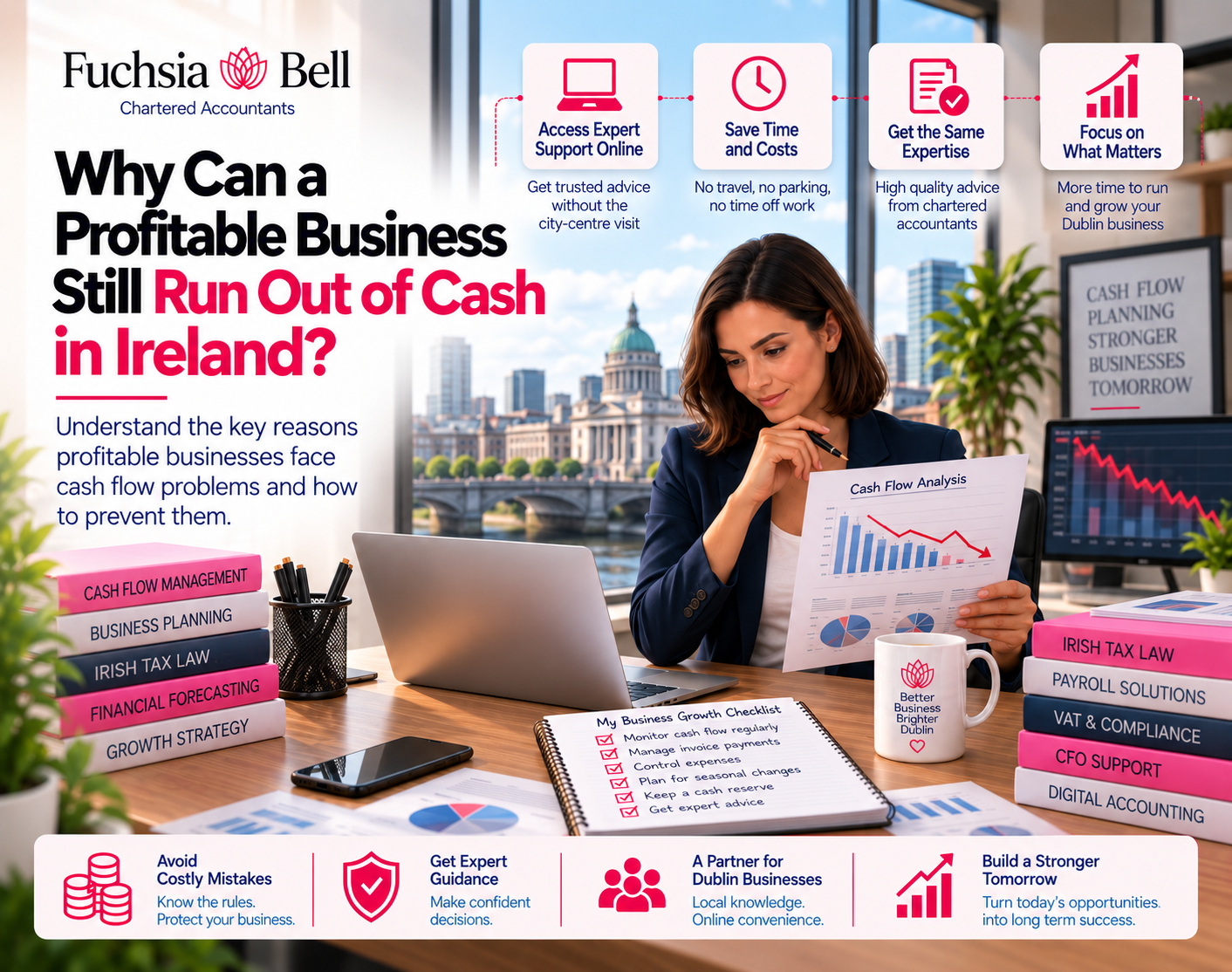
The accounts show a profit. The bank account shows a problem. This happens often enough in Irish SMEs that there is a standard name for it: the cash flow squeeze. Understanding why profit and cash move independently of each other is the first step toward making sure the profit actually appears where it matters.
Profit Is a Calculation, Not a Bank Balance
Profit is calculated on the accrual basis: income is recorded when it is earned, not when it is received. If your business invoices €50,000 in December and collects payment in February, that €50,000 appears in this year’s accounts as income despite the cash not yet arriving. Costs incurred in December are also recorded this year. Profit says the year was good. The bank account in January says something different.
What VAT Does to Your Cash Position
VAT is a particular pressure point. A business on bi-monthly VAT returns collects VAT from customers, then pays it to Revenue on a fixed schedule regardless of whether those customers have paid. If customers are running 60 days late, the business may be remitting corporation tax and VAT on invoices it has not yet collected. The Revenue deadline does not wait for customer payment.
How Credit Terms Create the Gap
Standard 30-day or 60-day customer payment terms mean cash lags behind revenue by weeks or months. If suppliers also extend credit, that gap narrows somewhat, but the timing is rarely symmetrical. Businesses that buy stock quickly, sell it at a delay, and collect payment slowly have a structural cash timing problem that no amount of profit in the accounts resolves. Clean bookkeeping records showing the actual receipt dates alongside invoice dates make the timing gap visible before it becomes a crisis.
The Growth Trap
Growth makes the cash problem worse before it makes it better. More revenue means more stock to buy, more invoices outstanding, and more payroll to cover in advance of collections. A company that doubles its sales often doubles its debtors at the same time. Profitable growth can consume cash faster than profitable trading generates it.
PAYE, PRSI, and the Monthly Obligation
For any business with employees, PAYE, PRSI, and USC are due to Revenue on a strict monthly schedule. There is no grace period tied to cash receipts. Missing a payroll tax deadline generates interest charges and penalty exposure immediately. The income tax return position for directors is separate from the company’s payroll obligation, but both run on calendar deadlines rather than cash flow cycles.
Reading Cash Flow Correctly
A cash flow statement shows the movement of actual money in and out of a business over a period, separated into operating, investing, and financing activities. It is a different document from the profit and loss account. A business profitable on paper but investing heavily in equipment or repaying a loan will show a negative cash position alongside solid profits. Reading both documents together is what gives the real picture.
Questions About Business Cash Flow
Is it possible to be technically insolvent while still making a profit?
Yes. Insolvency is defined by an inability to pay debts as they fall due, not by whether the accounts show a loss. A profitable business with a large debtor book and immediate creditor obligations can be insolvent despite looking healthy on the profit and loss account.
What is working capital and why does it matter?
Working capital is the difference between current assets (cash, debtors, stock) and current liabilities (trade creditors, VAT due, PAYE due). A positive working capital figure means the business can cover short-term obligations from short-term assets. When it turns negative, cash pressure follows regardless of profitability.
Can Revenue defer VAT payments if cash flow is genuinely tight?
In limited circumstances, yes. Revenue has a phased payment arrangement process for businesses facing genuine short-term difficulty. Engaging proactively is always better than missing a filing date without explanation.
What options are there if we run out of cash before receipts catch up?
An overdraft facility, invoice discounting to access debtors’ value early, a short-term business loan, or renegotiating creditor payment terms. The sooner the problem is identified, the more options remain available.
How do I separate personal money from business money properly?
A separate business bank account is the minimum. For limited companies it is a legal requirement. For sole traders it is not mandatory but it is strongly advisable, both for tax for company directors purposes and for understanding the actual cash position of the business clearly.
Can profitable months be used to buffer cash for difficult ones?
Yes. Forecasting cash flow over a 12-month rolling basis, not just the current month, lets you anticipate periods where outflows will exceed inflows. Holding a reserve from profitable periods specifically for this smoothing purpose is standard practice for businesses with seasonal trading.
What does a useful cash flow forecast look like?
A monthly projection of expected receipts, based on invoice dates and average payment periods, against expected payments to creditors, Revenue, payroll, and fixed costs. Updated monthly with actuals compared to forecast. The forecast does not need to be complex, but it needs to be current.
Should we focus more on chasing customers to pay or on managing the bank balance?
Both, but systematic debtor chasing tends to produce faster results than general cash management. Setting clear payment terms upfront, issuing invoices promptly, and following up at 30, 45, and 60 days keeps the cash conversion cycle as short as possible.
When the Accounts and the Bank Account Stop Agreeing
Spotting the gap between profit and cash early is considerably better than discovering it at the point a payment cannot be made. A structured look at debtor days, creditor terms, VAT timing, and payroll obligations takes under an hour with the right figures in front of you.
How We Help Irish Businesses Track Cash Alongside Profit
Understanding both the profit statement and the cash position is part of how we work with clients. Regular bookkeeping and accounts structured around actual receipts and payments, rather than invoices alone, gives a clearer real-time picture. For clients who want to run regular cash flow forecasts alongside their accounts, that sits within our advisory services as a standard part of the engagement.